
Liriomyza arctii
Spencer, 1969
Burdock Leafminer
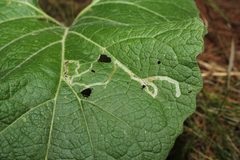
A small leaf-mining fly in the Agromyzidae, described by Spencer in 1969. The is known by the Burdock Leafminer and has been recorded from Vermont and other parts of the United States. Like other members of the Liriomyza, it is presumed to feed on plant tissues as larvae, creating characteristic mines within leaves.
Pronunciation
How to pronounce Liriomyza arctii: //ˌlaɪriːəˈmaɪzə ˈɑrkti.aɪ//
These audio files are automatically generated. While they are not always 100% accurate, they are a good starting point.
Images
Distribution
Recorded from Vermont, United States. Distribution records are sparse, suggesting either limited range or undercollection.
Host Associations
- Arctium - Presumed based on 'Burdock Leafminer', though direct confirmation is not documented in provided sources.
Similar Taxa
- Liriomyza huidobrensisBoth are leaf-mining agromyzids, but L. huidobrensis is a major agricultural pest with documented thermal and broad range, whereas L. arctii lacks such detailed study.
- Liriomyza sativaeSimilar leaf-mining habit and membership; L. sativae is better studied and shows competitive displacement patterns with congeneric in overlapping ranges.
More Details
Taxonomic note
The epithet 'arctii' likely derives from the Arctium (burdock), suggesting the original description or association with this plant genus. However, the original description by Spencer (1969) has not been directly consulted in these sources.
Data limitations
This is notably data-deficient compared to like L. huidobrensis and L. sativae, which have been extensively studied due to their agricultural pest status. Most biological details for L. arctii remain undocumented in accessible literature.
Sources and further reading
- BugGuide
- GBIF taxonomy match
- iNaturalist taxon
- Catalogue of Life
- Primary Type List | Entomology Research Museum
- Sheep Moths Draw Attention at Bohart Museum of Entomology Open House | Bug Squad
- Arctiidae | Beetles In The Bush
- Predicting Shifts in the Range of Invasive Insect Species in the Face of Climate Change
- “Candy” Scales Discovered in Dozens of Moth Species
- What do insects do in winter, Part 2? Tolerating the big chill: Banded woolly bears, Pyrrharctia isabella, field crickets, Gryllus spp., baldfaced hornets, Dolichovespula maculata, and others — Bug of the Week