
Peleteria
Robineau-Desvoidy, 1830
Species Guides
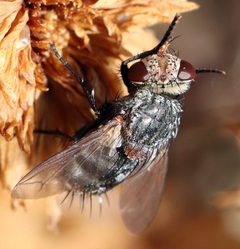
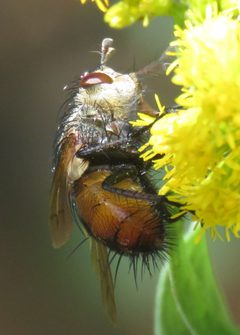
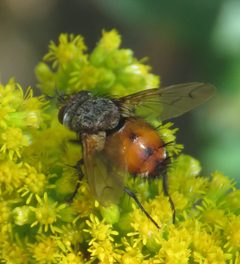
3Peleteria is a widespread of tachinid flies (Diptera: Tachinidae) comprising approximately 100 described distributed across multiple continents. Members of this genus are larval endoparasitoids of various insect , including caterpillars and other herbivorous insects. The genus is taxonomically divided into several subgenera based on morphological characters. Peleteria species contribute to natural of agricultural and forest pests.
Pronunciation
How to pronounce Peleteria: /ˌpe.leˈte.ri.a/
These audio files are automatically generated. While they are not always 100% accurate, they are a good starting point.
Identification
The is characterized by two prominent setae located in front of the lower part of the , a diagnostic feature visible upon close examination. -level identification requires examination of additional morphological characters including chaetotaxy, coloration patterns, and male terminalia.
Images
Habitat
Terrestrial associated with insect ; occurs in agricultural fields, grasslands, and other environments where lepidopteran larvae and other hosts are present. Specific microhabitat use varies by .
Distribution
Widespread across Palearctic, Nearctic, Neotropical, Oriental, Afrotropical, and Australasian regions. Documented from North America, South America, Europe, Asia, and Africa. GBIF records indicate presence in Denmark, Norway, and Sweden.
Diet
Larval endoparasitoid; larvae develop internally within living insects, consuming host tissues from the inside.
Host Associations
- Mythmina (Pseudaletia) sequax (wheat armyworm) - larval endoparasitoidPeleteria robusta specifically parasitizes fourth to sixth instars, with preference for fourth and fifth instars
- Monarch caterpillars and chrysalids (Danaus plexippus) - larval endoparasitoidObserved in Peleteria generally, though specific species not identified
- Pieris rapae (cabbage white butterfly larvae) - larval endoparasitoidDocumented for context
Life Cycle
Females deposit on the exterior surface of insects. Eggs eclose within 24 hours, and larvae penetrate the host shortly after hatching. Only one typically completes development per host despite multiple eggs being laid, likely due to . Larva consumes host tissues internally, eventually killing the host. Pupal stage occurs within or adjacent to the host remains. Development is temperature-dependent; for P. robusta, total development from oviposition to ranges from 23.8 days at 30°C to 90.3 days at 15°C, with optimal emergence at 20-25°C.
Behavior
visit flowers for nectar, serving as while foraging. Females actively search for suitable instars, showing preference for larger, more developed larvae. Multiple may be deposited on a single host, though typically only one survives to adulthood.
Ecological Role
Important natural enemies in terrestrial and agricultural systems. Member of that contribute to natural suppression of lepidopteran pest , including armyworms and other cereal crop pests. flower visitation provides incidental pollination services.
Human Relevance
Valued for services in agriculture, particularly for management of chewing pests in cereal crops and other systems. No known negative impacts on humans.
Similar Taxa
- Other Tachinidae generaMany tachinid share similar body plan and lifestyle; Peleteria distinguished by the two prominent facial setae below the and specific chaetotaxy patterns
- JanthinomyiaPhylogenetically closely related based on mitochondrial analysis; morphological separation requires detailed examination
- Lydina aeneaForms a clade with Peleteria iavana and Janthinomyia sp. based on molecular ; distinguished by morphological characters
More Details
Subgeneric classification
The contains four recognized subgenera: Peleteria (sensu stricto), Oxydosphyria, Panzeriopsis, and Sphyrimyia, plus numerous unplaced . Subgeneric assignment is based on morphological characters, primarily of the male terminalia and structure.
Thermal biology
For P. robusta, thermal constants have been calculated: + larval stages require 266.9 above 6.7°C; pupal stage requires 235.5 degree-days above 9.7°C; total development requires 457.5 degree-days above 9.3°C.
Molecular resources
The complete mitochondrial of P. iavana (15,697 ) represents the first mitogenome available for the , providing phylogenetic resolution suggesting Tachininae is not monophyletic.
Sources and further reading
- BugGuide
- Wikipedia
- GBIF taxonomy match
- NCBI Taxonomy
- Catalogue of Life
- What's It Like to Be Parasitized? | Bug Squad
- Bug Squad
- Why Flies Are Fantastic | Bug Squad
- It's Friday Fly Day! | Bug Squad
- The End Is Near | Bug Squad
- Host Instar Preference of Peleteria robusta (Wiedman) (Diptera: Tachinidae) and Development in Relation to Temperature
- The complete mitochondrial genome of Peleteria iavana (Diptera, Tachinidae) in Guizhou, China, and its phylogenetic placement.