
Voria ruralis
(Fallén, 1810)
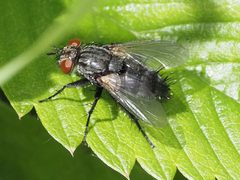
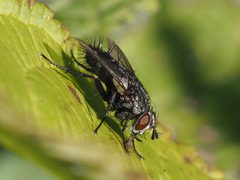
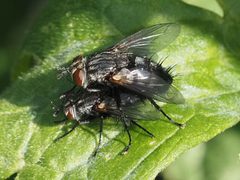
Voria ruralis is a tachinid fly that parasitizes lepidopteran larvae, particularly noctuid including the cabbage looper (Trichoplusia ni) and soybean looper (Pseudoplusia includens). It is widely distributed across North America, South America, Europe, Asia, Africa, and Australia. The has been documented as a agent in agricultural systems, with rates reaching over 20% on some . Developmental time varies with temperature, and females exhibit host discrimination when selecting targets for oviposition.
Pronunciation
How to pronounce Voria ruralis: /ˈvɔːriə rʊˈreɪlɪs/
These audio files are automatically generated. While they are not always 100% accurate, they are a good starting point.
Identification
As a member of Tachinidae, Voria ruralis possesses the characteristic bristly body and reduced wing venation typical of the . Specific morphological features distinguishing it from congeneric are not documented in available sources. Identification to species level likely requires examination of male terminalia or molecular markers.
Images
Habitat
Agricultural fields and natural where lepidopteran larvae occur, including cabbage fields and soybean fields.
Distribution
Widely distributed across six continents: North America (Canada, United States, Mexico), South America (Argentina, Brazil, Chile, Colombia, Peru, Uruguay, Venezuela, Trinidad and Tobago), Europe (British Isles through Eastern Europe and Mediterranean regions), Asia (China, Japan, South Korea, Iran, Israel, India, Nepal, Pakistan, Taiwan, Russia, Mongolia), Africa (Kenya, South Africa, Yemen), and Oceania (Australia, Papua New Guinea).
Seasonality
Seasonal occurrence has been documented in Arizona; specific timing varies with regional climate and availability.
Diet
Larval stage is , feeding internally on lepidopteran larvae. feed on nectar and other liquid sources.
Host Associations
- Trichoplusia ni - cabbage looper; rate of 20.67% recorded in Coahuila, México
- Pseudoplusia includens - soybean looper
- Spodoptera frugiperdamentioned in same study but attributed to Archytas marmoratus, not V. ruralis
Life Cycle
Females deposit on or near larvae. Larval development occurs internally within the host, with pupariation taking place after host death. emerge from the . Development time from egg to adult varies with temperature.
Behavior
Females exhibit discrimination when selecting targets for oviposition. Multiple may be deposited on a single host, potentially leading to larval competition. The has been successfully reared in laboratory culture.
Ecological Role
Acts as a agent of agricultural pest lepidopteran larvae, particularly loopers in cabbage and soybean cropping systems. levels can reach over 20% on susceptible .
Human Relevance
Used or considered for programs targeting noctuid pests in agriculture. Its activity against crop pests like and soybean loopers provides natural suppression of pest .
Similar Taxa
- Archytas marmoratusBoth are tachinid of agricultural pest lepidopterans; distinguished by associations and likely morphological features of male terminalia
More Details
Developmental Biology
Laboratory studies have quantified developmental rates at various temperatures, enabling prediction of times under different environmental conditions.
Geographic Variation
A South American has been studied separately, suggesting potential geographic variation in biological characteristics.
Sources and further reading
- BugGuide
- Wikipedia
- GBIF taxonomy match
- iNaturalist taxon
- NCBI Taxonomy
- Catalogue of Life
- New Technique May Help Farmers Identify the European Corn Borer
- Stoneflies mapped across Ohio, with implications for water quality and nature conservation | Blog
- Biology of Voria ruralis (Diptera: Tachinidae)1
- Time Required for Development of Voria ruralis and Its Host, the Cabbage looper, at Different Temperatures123
- Primer registro de Archytas marmoratus y Voria ruralis (Diptera: Tachinidae) y sus niveles de parasitoidismo en dos lepidópteros plaga en Coahuila, México
- Seasonal Occurrence of Voria ruralis a Parasite of the Cabbage Looper, in Arizona, and Its Behavior and Development in Laboratory Culture1
- Biological Characteristics of a South American Population of Voria ruralis (Diptera: Tachinidae), a Larval Parasitoid of the Soybean Looper (Lepidoptera: Noctuidae) 1
- Influence of Three Soybean Genotypes on Development of Voria ruralis (Diptera: Tachinidae) and on Foliage Consumption by Its Host, the Soybean Looper (Lepidoptera: Noctuidae)