
Ochthera
Latreille, 1802
Mantid Shoreflies
Species Guides
4- Ochthera anatolikos
- Ochthera lauta
- Ochthera mantis(mantis fly)
- Ochthera tuberculata(shore fly)
Ochthera is a of predatory shore flies (Ephydridae) distinguished by forelegs modified for seizing prey. and larvae are exclusively predatory, feeding on and mosquito larvae. The genus has a global distribution with approximately 37-55 , including 13 species in North America. Some species have documented significance as of , including African vectors.
Pronunciation
How to pronounce Ochthera: /ˈɒkθɪrə/
These audio files are automatically generated. While they are not always 100% accurate, they are a good starting point.
Identification
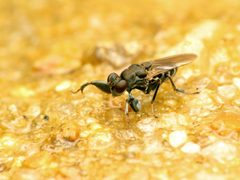
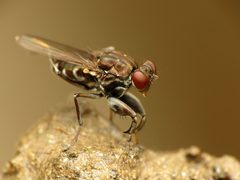
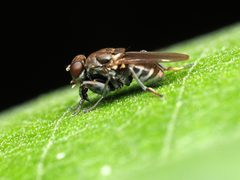
Easily recognized by the swollen, mantis-like forelegs—greatly enlarged and curved tibiae adapted for seizing prey. This modification is unique among shore flies (Ephydridae) and distinguishes Ochthera from all other in the . The compact body, triangular , and protuberant are additional supporting characters. Foreleg waving may be observed in live specimens.
Images
Appearance
Small, compact flies measuring 4-5 mm in body length. Triangular with somewhat protuberant . Most distinctive feature is the pair of heavily modified forelegs: enlarged , greatly enlarged muscular , and curved blade-like tibia with spines and tiny teeth on the inner femur surface for gripping prey. of normal appearance. Body is squat and compact overall.
Habitat
Found in shallow aquatic and semi-aquatic environments: very shallow trickling streams, shorelines, and margins of water bodies with algal mats and debris. run on moist substrates in search of prey. Larvae are aquatic or semi-aquatic, occurring in shoreline muck and shallow water.
Distribution
distribution with records from North America, South America (Colombia), Europe (Denmark, Norway, Sweden), China, and Africa. In North America, distributed across most of the continent. In China, documented from Guangdong and Hainan provinces among other regions.
Seasonality
active from end of March through end of October in temperate North America. Timing varies by region.
Diet
Exclusively predatory. feed on adult , mosquitoes, and other small insects such as leafhoppers. Larvae prey on midge larvae (Chironomidae) and mosquito larvae, coiling around prey and using piercing mouthparts to feed on internal soft tissues.
Life Cycle
: laid singly on dead, water-logged, or partly submerged grass stems at shore or in shallows. Larva: three instars, aquatic or semi-aquatic, predatory; lasts 7-11 days under laboratory conditions. Pupa: aquatic, equipped with breathing tubes; lasts 7-10 days. Total development from egg to approximately 16-21 days under laboratory rearing conditions.
Behavior
exhibit distinctive foreleg waving and stretching, possibly serving as threat displays or recognition to avoid . Spreading and waving of forelegs occurs during same-sex encounters and male-female approaches. Males attempt to mount females from behind, tapping female with hind feet; females may lash out at unwanted males. Mating lasts at least five minutes. Adults probe sand with to detect prey, then excavate larvae using fore tibial spines and hold prey between tibia and while consuming.
Ecological Role
in aquatic and shoreline , controlling of and mosquitoes. Documented predator of including African vector mosquitoes.
Human Relevance
Potential agent for mosquito and . Ochthera chalybescens has been documented preying on African vectors.
More Details
Taxonomic uncertainty
counts vary between sources: approximately 37 species per Wikipedia, 55 species per Eric, with 13 species documented in North America.
Display function uncertainty
The function of foreleg waving displays remains incompletely understood—whether threat, recognition, or courtship signaling has not been definitively established.