
Ochthera mantis
(De Geer, 1776)
mantis fly, mantis shore fly
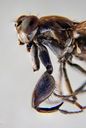
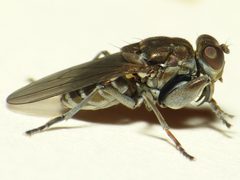
Ochthera mantis is a predatory shore fly in the Ephydridae, first described by Charles De Geer in 1776. The is notable for its forelegs, which are modified for seizing prey and resemble those of praying mantises—hence its . Both and larvae are predatory, with adults hunting small insects along shorelines and larvae feeding aquatically on and mosquito larvae. It is a Holarctic species with a limited distribution in Europe.
Pronunciation
How to pronounce Ochthera mantis: /ˈɒkθərə ˈmæntɪs/
These audio files are automatically generated. While they are not always 100% accurate, they are a good starting point.
Identification
Distinguished from other shore flies by its forelegs with enlarged and curved tibiae, resembling those of a praying mantis. The compact, squat body and triangular are additional distinguishing features. Among the 13 North American Ochthera , specific identification to O. mantis requires examination of subtle morphological characters not detailed in available sources.
Images
Habitat
Primarily found on sandy or muddy shores of very shallow, trickling streams. Favors with algal mats and debris where can run in search of prey. Larvae are aquatic or semi-aquatic in shallow water and shoreline muck.
Distribution
Holarctic distribution with limited occurrence in Europe. Documented present in Denmark, Norway, and Sweden. North American distribution includes Colorado Springs and other locations across most of the continent, though specific range boundaries are not well-defined.
Seasonality
have been observed from end of March through end of October in appropriate .
Diet
prey on small insects including , mosquitoes, and leafhoppers that alight on shore or water surface. They also unearth midge larvae from shoreline muck. Larvae feed predominantly on midge and mosquito larvae, coiling around prey and penetrating the to consume soft internal tissues.
Life Cycle
Females lay singly on dead, water-logged, or partly submerged grass stems at the shore or in shallows. Larvae progress through three instars before pupating. Pupal stage is aquatic, equipped with breathing tubes. Under laboratory conditions, egg to development takes approximately 16–21 days (larval stages 7–11 days, pupal stage 7–10 days).
Behavior
periodically stretch and wave their forelegs, possibly as a threat display directed at conspecifics or as a recognition mechanism to avoid . Females may lash out at males attempting to mate. Males approach females from the rear, jumping on top and gripping the female's if not rebuffed; males rapidly tap the sides of the female's with their hind feet during courtship. Mating can last at least five minutes.
Ecological Role
in shoreline aquatic and semi-aquatic . and larvae help regulate of , mosquitoes, and other small insects in shallow water .
Human Relevance
No documented direct human relevance. Not known as a pest or as a of economic importance.
Similar Taxa
- Other Ochthera speciesShare foreleg ; 13 occur in North America, requiring detailed examination for separation.
- Praying mantises (Mantodea) of forelegs creates superficial resemblance, but Ochthera is a true fly (Diptera) with single pair of wings and , distinguishing it from mantises which have two pairs of wings and leathery forewings.
More Details
Mating behavior
Documented courtship includes male tapping of female with hind feet and extended copulation duration.
Sources and further reading
- BugGuide
- Wikipedia
- GBIF taxonomy match
- iNaturalist taxon
- NCBI Taxonomy
- Catalogue of Life
- Magical Mantis Moments | Bug Squad
- Bug Eric: Mini-mantises: Ochthera Shore Flies
- Surviving winter, Part III: Egg cases of the Praying mantis, Mantis religiosa, Chinese mantis, Tenodera sinensis, and Carolina mantis, Stagmomantis carolina — Bug of the Week
- Decorations on the Christmas tree: Egg cases of the European mantis, Mantis religiosa, Chinese mantis, Tenodera sinensis, and Carolina mantis, Stagmomantis carolina — Bug of the Week
- Old World mantis with New World tastes: European Mantis, Mantis religiosa — Bug of the Week
- Decorations on the Christmas tree: Egg cases of the European mantis, Mantis religiosa, Chinese mantis, Tenodera sinensis, and Carolina mantis, Stagmomantis carolina — Bug of the Week