
Ochlerotatus sollicitans
(Walker, 1856)
eastern saltmarsh mosquito, salt marsh mosquito
Ochlerotatus sollicitans, commonly known as the eastern saltmarsh mosquito, is a floodwater mosquito native to coastal regions of eastern North America. It is a significant pest species known for aggressive biting and daytime activity. The species is a competent for several including virus and West Nile virus. Its can explode following tidal flooding or heavy rainfall events in salt marsh .
Pronunciation
How to pronounce Ochlerotatus sollicitans: /ˌɔklɛroʊˈteɪtəs ˌsɒlɪˈsɪtænz/
These audio files are automatically generated. While they are not always 100% accurate, they are a good starting point.
Identification
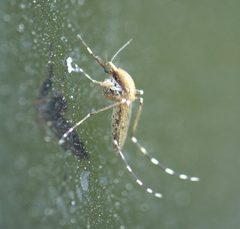
Distinguished from other Ochlerotatus by the combination of a pale scutal stripe, banded legs, and pale-banded . Similar to Ochlerotatus taeniorhynchus (black salt marsh mosquito) but differs in coloration—O. sollicitans is golden-brown rather than predominantly black. Ochlerotatus canadensis lacks the pale proboscis band. Identification to species level typically requires examination of genitalic structures or use of molecular methods.
Images
Habitat
Breeds primarily in salt marshes and brackish water along coastal areas. Larval development occurs in temporary pools formed by tidal flooding or rainfall in marsh environments. Also found in freshwater floodplain areas adjacent to coastal salt marshes. disperse from breeding sites into surrounding residential and recreational areas.
Distribution
Native to eastern North America from the Gulf Coast through the Atlantic seaboard to southern Canada. Range extends westward to the Great Lakes region. Also reported from the Caribbean and has been introduced to some Pacific regions. Most abundant in coastal plain environments from Florida to New England.
Seasonality
Active from late spring through early autumn in temperate regions. Peak typically occur in summer months (June–August) following breeding rainfall or tidal events. In southern portions of range, may be active nearly year-round with reduced winter activity.
Diet
Females blood-feed on mammals including humans, livestock, and wildlife to obtain protein for development. Both sexes feed on nectar and plant sugars for energy. Has been observed feeding on a wide range of including birds, which contributes to its role as a .
Host Associations
- humans - blood aggressive biter, active during daytime
- birds - blood and important for transmission cycles
- livestock - blood horses, cattle, and other domestic animals
- wild mammals - blood various including rodents and deer
Life Cycle
Females deposit on moist substrate in depressions that will flood. Eggs are to desiccation and can survive dry periods until flooding triggers hatching. Larvae develop through four instars in aquatic environments, feeding on organic matter and microorganisms. Pupae are aquatic and mobile. emerge from pupae and disperse from breeding sites. time varies with temperature but can be as short as 7–10 days under optimal conditions.
Behavior
activity with peak biting during daylight hours, particularly morning and late afternoon. Known for aggressive, persistent biting . are strong fliers and can disperse 5–10 miles or more from breeding sites. Females exhibit -seeking behavior using visual cues, carbon dioxide, and other host-emitted compounds. Males form mating swarms, typically near conspicuous landmarks.
Ecological Role
Serves as a significant food source for aerial including birds, bats, and . Larval stages contribute to nutrient cycling in aquatic marsh . As a , plays a role in transmission cycles, connecting bird to mammalian including humans.
Human Relevance
Major nuisance pest in coastal recreational and residential areas due to aggressive daytime biting. Significant public health concern as a of virus, West Nile virus, and potentially other . Economic impacts on tourism and outdoor recreation in affected coastal regions. Subject to extensive mosquito control efforts including larviciding and adulticiding in salt marsh .
Similar Taxa
- Ochlerotatus taeniorhynchusAlso a salt marsh breeder, but predominantly black in color rather than golden-brown; lacks pale band
- Ochlerotatus canadensisSimilar size and preferences, but lacks pale band on and has different scutal markings
- Aedes aegyptiShares daytime biting , but is a container breeder in urban environments with distinctive white lyre-shaped markings on
More Details
Taxonomic Note
Ochlerotatus has been treated as both a and a subgenus within Aedes. Current classification varies by source; GBIF treats O. sollicitans as a synonym of Aedes sollicitans, while NCBI maintains Ochlerotatus as a valid genus.
Vector Competence
Laboratory studies have demonstrated competence for multiple , though field isolation rates vary by region and year. Vectorial capacity is influenced by -feeding patterns favoring both birds and mammals.
Sources and further reading
- BugGuide
- GBIF taxonomy match
- NCBI Taxonomy
- Another Invasive Mosquito Species Arrives in Florida
- Two tiny vampires leave their itchy calling cards along the Potomac: black flies, Simuliidae and no-see-ums, Ceratopogonidae — Bug of the Week
- Mosquito redux - Culicidae — Bug of the Week
- Mosquito Management in the Era of Extreme Weather
- Bug Eric: My Personal National Moth Week, 2017
- Bug Eric: September 2017