
Boletina
Staeger, 1840
fungus gnats
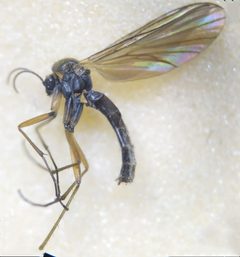
Boletina is a -rich of fungus gnats in the Mycetophilidae, characterized by a mainly Holarctic distribution. The genus has historically been taxonomically challenging due to morphological similarities among species and relationships with related genera including Aglaomyia, Coelosia, and Gnoriste. Recent molecular phylogenetic studies and taxonomic revisions have clarified some relationships, though the genus remains under active investigation. Boletina species are particularly diverse in northern Europe, where ongoing research continues to reveal new species.
Pronunciation
How to pronounce Boletina: /bɒlɛtina/
These audio files are automatically generated. While they are not always 100% accurate, they are a good starting point.
Identification
Boletina are distinguished from related fungus gnat primarily through detailed examination of genitalia , particularly male terminalia. The Boletina erythropyga species group forms a consistently distinct basal clade. Molecular markers including nuclear 28S and mitochondrial 16S, COI, and CytB are used for phylogenetic resolution where morphological characters are ambiguous. The genus is with respect to Aglaomyia, Coelosia, and Gnoriste, while Saigusaia appears well-separated. Species-level identification typically requires dissection and microscopic examination of genitalic structures.
Images
Habitat
Boletina are associated with old-growth forests, mires, and wetlands. Specific collecting localities for newly described species have been situated in old-growth reservations or suggested for protection. The shows particular affinity for northern boreal and Arctic environments.
Distribution
Mainly Holarctic distribution. Documented from Fennoscandia (Finland, Sweden, Norway), Russian Karelia, Denmark, and North America including Yukon and Canada. The exhibits an anomalous diversity gradient with particularly high in northern Europe—approximately 1000 occur in the Scandinavian Peninsula, representing about 83% of Europe's total fungus gnat fauna.
Human Relevance
Boletina serve as indicators of old-growth forest and wetland quality. Their presence has been used to identify habitats warranting conservation protection. The is a focus of ongoing biodiversity inventory work in northern Europe, where it represents a significant component of regional insect diversity.
Similar Taxa
- DocosiaHypothesized sister-group relationship with Boletina based on molecular phylogenetic analysis
- SaigusaiaHistorically considered potentially congeneric but molecular data show it is well separated from Boletina
- AglaomyiaNested within the Boletina clade in phylogenetic analyses, contributing to paraphyly of Boletina as currently delimited
- CoelosiaNested within the Boletina clade in phylogenetic analyses
- GnoristeNested within the Boletina clade in phylogenetic analyses
More Details
Taxonomic complexity
Molecular phylogenetic studies using 28S, 16S, COI, and CytB markers have revealed that Boletina as traditionally circumscribed is . The inclusion of additional 18S sequences in analyses helped resolve some of the topological instability that caused breakdown of traditional higher-level classification.
Species discovery
At least nine new Boletina were described from Fennoscandia between 2014-2016, with additional species continuing to be discovered. Approximately 100 Fennoscandian fungus gnat species, many in Boletina, await formal description.
Research significance
The has been the subject of molecular phylogenetic investigation specifically to test the segregation of Saigusaia and Aglaomyia from Boletina, representing one of the first systematic attempts to resolve relationships within this taxonomically neglected group.
Sources and further reading
- BugGuide
- Wikipedia
- GBIF taxonomy match
- iNaturalist taxon
- NCBI Taxonomy
- Catalogue of Life
- fungus gnat | Blog
- fly | Blog
- Uncategorized | Blog - Part 6
- entomology | Blog - Part 17
- Diptera | Blog - Part 2
- New species of the genus Boletina Winnertz (Diptera: Mycetophilidae) from Fennoscandia
- Towards a molecular phylogeny of the fungus gnat genus Boletina (Diptera: Mycetophilidae)
- <i>Boletina dispectoides</i> sp.n. and six other species of fungus gnats (Diptera: Mycetophilidae) new to Finland