
Leia bivittata
Say, 1829
fungus gnat
Leia bivittata is a of in the Mycetophilidae, first described by Thomas Say in 1829. It belongs to the Leia, a group of small flies commonly associated with decaying organic matter and fungal . The species epithet "bivittata" refers to two longitudinal stripes or bands, likely describing a distinctive color pattern on the body or wings. Like other members of Mycetophilidae, the larvae are presumed to develop in moist, decomposing substrates.

Pronunciation
How to pronounce Leia bivittata: /ˈleɪ.ə baɪˈvɪt.ə.tə/
These audio files are automatically generated. While they are not always 100% accurate, they are a good starting point.
Identification
The specific epithet "bivittata" provides the primary diagnostic feature: presence of two longitudinal stripes or bands. Within the Leia, identification to requires examination of these striping patterns and likely genitalic characters. Distinguished from other Mycetophilidae genera by the combination of Leia-type wing venation and antennal structure. Accurate identification typically requires microscopic examination and comparison with or authoritative keys.
Images
Appearance
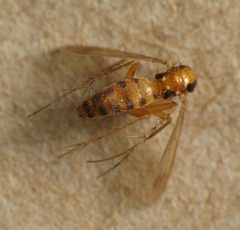
are small, delicate flies with the characteristic slender build of fungus gnats. The specific epithet "bivittata" indicates the presence of two longitudinal stripes or vittae, most likely on the or . Members of the Leia typically have long and relatively long legs compared to body size. Wing venation follows the reduced pattern typical of Mycetophilidae, with few crossveins.
Habitat
Moist environments with abundant fungal growth or decaying organic matter; typical for Mycetophilidae includes forest floors, decaying wood, and leaf litter.
Distribution
Described from North America (Say, 1829); specific range details require further verification from specimen records.
Ecological Role
Larvae of Mycetophilidae are generally saprophagous or mycophagous, contributing to decomposition processes and nutrient cycling in forest .
Similar Taxa
- Other Leia speciesShare the same characteristics; distinguished by specific striping patterns and subtle morphological differences
- Other Mycetophilidae generaSimilar overall appearance as fungus gnats; distinguished by wing venation patterns and antennal structure
More Details
Etymology
The specific epithet "bivittata" derives from Latin "bi-" (two) and "vittatus" (banded or striped), directly describing the ' most notable visual characteristic.
Taxonomic history
First described by Thomas Say in 1829, an early American entomologist whose work established the foundation for North American insect .