
Poecilanthrax lucifer
(Fabricius, 1775)
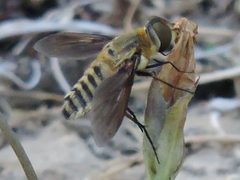
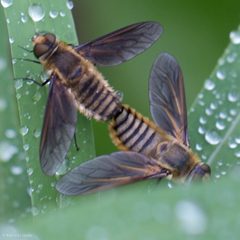
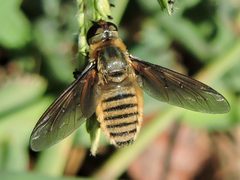
Poecilanthrax lucifer is a of bee fly ( Bombyliidae) in the Poecilanthrax, a strictly North American group. are distinguished by conspicuous black and yellow tomentose crossbands on the and yellow or tan bases on the larger wing that contrast with the remainder of the wing pattern. The species has a notably wide distribution, occurring in the West Indies, southern Gulf States, Central America, and northward into Arkansas and southern Illinois. Larvae develop as inside caterpillars of cutworms and armyworms (family Noctuidae), with documented including fall armyworm (Spodoptera frugiperda). Uniquely among its genus, P. lucifer has also been reported as a hyperparasite of Myzine haemorrhoidalis (family Tiphiidae), a primary parasite of white (genus Phyllophaga) in Puerto Rico.
Pronunciation
How to pronounce Poecilanthrax lucifer: //ˌpʊɪsɪˈlænθræks ˈluːsɪfər//
These audio files are automatically generated. While they are not always 100% accurate, they are a good starting point.
Identification
Distinguished from other Poecilanthrax by the combination of black and yellow tomentose crossbands on the and yellow or tan bases on the larger wing that contrast with the rest of the wing. Other lack this specific wing vein coloration pattern.
Images
Habitat
have been observed perching on flowers of plains snakecotton (Froelichia floridana) in sandy areas. The occurs in open, sandy including sand scrub and post oak savanna regions.
Distribution
Widely distributed: West Indies, southern Gulf States of the USA, Central America, northward to Arkansas and southern Illinois. Specific locality records include Sand Flat Cemetery in Henderson County, Texas, and the Lake Wales Ridge of central Florida.
Seasonality
active in late September and early October based on field observations in Texas. In agricultural areas, may become facultatively or multivoltine due to extended seasonal availability of pest caterpillars; in natural .
Host Associations
- Spodoptera frugiperda - fall armyworm; rates up to 25% have been documented
- Myzine haemorrhoidalis - hyperparasiteprimary of white (Phyllophaga); reported from Puerto Rico
- Phyllophaga - indirectwhite ; hyperparasitism via Myzine haemorrhoidalis
- Froelichia floridana - perch/flower visitorplains snakecotton; perch on flowers
Life Cycle
Larvae develop as inside noctuid caterpillars (cutworms and armyworms). All Poecilanthrax appear to be in natural , though P. lucifer and some others may become facultatively or multivoltine in agricultural settings due to extended availability.
Behavior
perch on flowers and are described as skittish and difficult to photograph. Like other bee flies, adults are likely fast, agile fliers.
Ecological Role
of noctuid caterpillars, potentially providing of agricultural pests such as fall armyworm. Acts as hyperparasite in some contexts. may contribute to pollination through flower visitation.
Human Relevance
Potential agent for agricultural pests, particularly fall armyworm (Spodoptera frugiperda). Documented rates of up to 25% suggest significant impact on in some settings.
Similar Taxa
- Other Poecilanthrax speciesLack the distinctive yellow or tan bases on larger wing ; abdominal banding patterns differ
- Poecilognathus speciesAnother of bee flies that may occur in similar ; differs in wing venation and body patterning
Misconceptions
The has been subject to ominous misinterpretation: 'Anthrax' refers to the Greek meaning 'charcoal' (referring to the often black color of flies), not the ; 'Lucifer' derives from Latin 'light-bringing' or 'morning star,' not Satan.
More Details
Nomenclature
Originally described as Bibio lucifer by Fabricius in 1775. The Poecilanthrax was last revised by Painter & Hall (1960), who recognized 35 . The genus is strictly North American (sensu lato) with greatest abundance in the Great Basin region.
Voltinism flexibility
While most Poecilanthrax are strictly , P. lucifer shows ecological flexibility in agricultural environments where multiple may occur due to continuous availability.