
Poecilanthrax
Osten Sacken, 1886
Species Guides
21Poecilanthrax is a large of bee-flies ( Bombyliidae) primarily distributed in the Nearctic region. are robust flies with body lengths of 8–14 mm, characterized by large, elongate patterned wings with 2–3 submarginal and the absence of M2. The genus is notable for its parasitic , with larvae developing inside caterpillars of noctuid . Approximately 35 were recognized as of 1960, with greatest diversity in the Great Basin region.
Pronunciation
How to pronounce Poecilanthrax: /ˌpiː.sɪˈlæn.θræks/
These audio files are automatically generated. While they are not always 100% accurate, they are a good starting point.
Identification
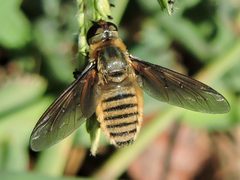
Distinguished from other -fly by the combination of large size, elongate patterned wings with 2–3 submarginal , absence of M2, and reduced front . -level identification relies on abdominal color patterns—particularly the presence and arrangement of tomentose (woolly-haired) bands—and wing vein coloration. For example, Poecilanthrax lucifer is recognized by black and yellow tomentose crossbands on the and yellow or tan bases on the larger wing veins contrasting with the remainder of the wing pattern.
Images
Appearance
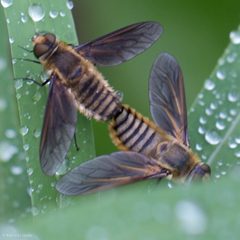
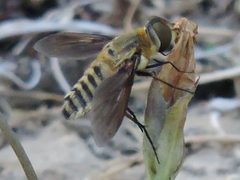
Large to robust flies measuring 8–14 mm in body length. Wings are large, elongate, and distinctly patterned, with 2 or 3 submarginal and M2 absent. The is moderately lengthened with 7 visible tergites. Front are reduced, and the tibiae are smooth. Wing venation and abdominal banding patterns provide key diagnostic features for identification.
Habitat
Occurs in diverse open including sand scrub, prairie, grassland, and agricultural areas. are frequently associated with flowering plants where they feed on pollen. Sandy substrates appear to be important for some , particularly where noctuid caterpillars are abundant.
Distribution
Primarily Nearctic, with distribution extending from Canada south through the United States into Central America. Greatest abundance occurs in the Great Basin region of western North America. Some species, such as P. lucifer, range widely from the West Indies and southern Gulf States north to Arkansas and southern Illinois.
Seasonality
are active during warmer months. Most appear to be (one per year) in natural , though some agricultural species may become facultatively or multivoltine due to extended seasonal availability of pest caterpillars.
Diet
feed on pollen. Larvae are that develop inside caterpillars of noctuid (Noctuidae), including cutworms and armyworms.
Host Associations
Life Cycle
Complete with , larval, pupal, and stages. Females deposit eggs near or on caterpillars. Larvae penetrate the host and develop internally, eventually killing the caterpillar. occurs in the soil. Most have one per year, though some may produce multiple generations where host availability permits.
Behavior
are rapid, agile fliers often observed visiting flowers for pollen. They exhibit characteristic -fly hovering . Some perch on bare ground or vegetation between foraging bouts. Females actively search for caterpillars to parasitize.
Ecological Role
Important agents of noctuid , including agricultural pests such as fall armyworm (Spodoptera frugiperda). rates of up to 25% have been documented for some . One species (P. lucifer) has been reported as a hyperparasite of a tiphiid that parasitizes white .
Human Relevance
Provides natural of agricultural pest caterpillars, potentially reducing reliance on chemical . The has been studied for its potential in managing noctuid pests in crop systems. No negative impacts on humans are documented.
Similar Taxa
- ExoprosopaBoth are large bee-flies with patterned wings, but Exoprosopa typically has different wing venation and abdominal structure
- BombyliusSimilar overall -fly , but Bombylius are generally smaller with different wing patterns and associations
Misconceptions
The name Poecilanthrax is sometimes misinterpreted as referencing the anthrax; however, 'anthrax' derives from Greek for 'charcoal,' likely referring to the often dark coloration of flies rather than the bacterial disease. The epithet 'lucifer' refers to the Latin meaning 'light-bringer' or 'morning star,' not Satan.
More Details
Taxonomic history
Last revised by Painter & Hall in 1960, who recognized 35 . The belongs to the tribe Villini within Anthracinae.
Hyperparasitism
Poecilanthrax lucifer is unique in the in having been documented as a hyperparasite of Myzine haemorrhoidalis ( Tiphiidae), a primary of white (Phyllophaga) in Puerto Rico.