
Exoprosopa
Macquart, 1840
Species Guides
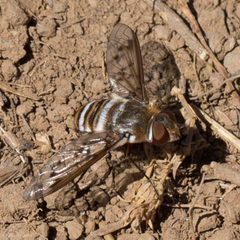
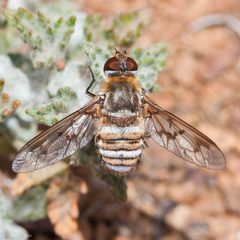
28Exoprosopa is a large of bee-flies (Bombyliidae) comprising over 325 described . Members are among the largest bee flies, reaching up to 22 mm body length and 64 mm wingspan. The genus exhibits striking wing patterns and abdominal banding, with many species showing . Species are found worldwide, with exceptional diversity in Southern Africa (over 135 species). As , they target a broad range of insects including locusts and larvae.
Pronunciation
How to pronounce Exoprosopa: //ɛksoʊˈproʊsoʊpə//
These audio files are automatically generated. While they are not always 100% accurate, they are a good starting point.
Identification
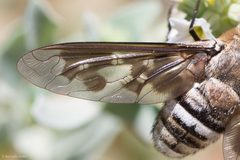
Distinguished from other -fly by combination of large size, loosely attached large , short , and boldly patterned wings. The banded abdominal pattern with white or pale on terminal segments is characteristic. in coloration occurs in many . Similar genera in Anthracinae may be separated by wing pattern details and abdominal scaling; precise identification often requires examination of genitalia.
Images
Appearance
Large-bodied bee flies, body length 6–22 mm (most 14 mm or larger). disproportionately large and loosely attached to . small and widely separated. short relative to body size. Wings exceptionally large, wingspan 40–64 mm, nearly always with bold contrasting patterns. patterned, often banded with white or pale on segments 6–7 or across all segments. Many exhibit in coloration or pattern.
Distribution
. Found on all continents except Antarctica. Southern Africa is a center of diversity with over 135 . Additional records from Europe, Mediterranean Basin, North Africa, Levant, southern Balkans, Scandinavia, and North America.
Host Associations
- locusts - larval
- wasp larvae - larval
Ecological Role
Larval of various insects; contributes to of orthopteran and hymenopteran .
Similar Taxa
- AnthraxSimilar large bee-flies in Anthracinae; Exoprosopa distinguished by loosely attached , short , and specific wing pattern elements
- VillaLarge bee-flies with patterned wings; Exoprosopa generally larger with more robust body and distinct abdominal banding
More Details
Taxonomic note
Exoprosopa pandora (Fabricius, 1805), the type , was long confused with E. baccha Loew, now synonymized. The species occurs in North Africa, the Levant, and southern Balkans.
Diversity
With over 325 described , Exoprosopa is one of the largest in Bombyliidae. The concentration of 135+ species in Southern Africa suggests a major radiation in that region.