
Poecilanthrax californicus
(Cole, 1917)
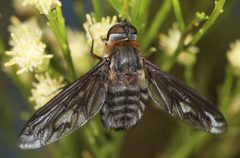
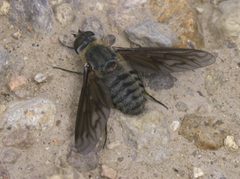
Poecilanthrax californicus is a of bee fly in the Bombyliidae, first described by Cole in 1917. As a member of the Poecilanthrax, it belongs to a strictly North American group of bee flies whose larvae develop as inside caterpillars of various cutworms and armyworms (family Noctuidae). The species epithet 'californicus' suggests a primary association with California, though specific details about its and distribution remain limited in available sources.
Pronunciation
How to pronounce Poecilanthrax californicus: /ˌpiːsɪˈlænθræks ˌkælɪˈfɔːrnɪkəs/
These audio files are automatically generated. While they are not always 100% accurate, they are a good starting point.
Images
Distribution
California and western North America, based on epithet and distribution patterns. The genus Poecilanthrax is most diverse in the Great Basin region, with species distributed from Canada south through Central America.
Diet
likely feed on nectar from flowers. Larvae are of noctuid caterpillars (cutworms and armyworms), based on documented for the Poecilanthrax.
Host Associations
- Noctuidae - larval Larvae develop as inside caterpillars of cutworms and armyworms; this is documented for the Poecilanthrax generally
Life Cycle
Complete with , larva, pupa, and stages. Larval development occurs inside caterpillars. Specific details for P. californicus are not documented, but are (one per year) in natural .
Ecological Role
of noctuid caterpillars, contributing to natural of these herbivores.
Similar Taxa
- Poecilanthrax luciferBoth are large bee flies in the same with black and yellow tomentose patterning; P. lucifer is distinguished by conspicuous black and yellow crossbands on the and yellow or tan bases of larger wing
- Other Poecilanthrax speciesApproximately 35 in the , many with similar overall bee fly ; species-level identification requires examination of specific pattern details and wing venation coloration
Sources and further reading
- BugGuide
- Wikipedia
- GBIF taxonomy match
- iNaturalist taxon
- Catalogue of Life
- Encyrtid Holdings | Entomology Research Museum
- California Has No State Bee--Yet! | Bug Squad
- Bohart Museum: Learn about California's State Insect on UC Davis Picnic Day | Bug Squad
- Diptera | Beetles In The Bush | Page 3
- Sex Attraction Pheromone Improves Detection of a Threatened Beetle
- Just how widespread is Prionus heroicus? | Beetles In The Bush