
Chelisoches morio
(Fabricius, 1775)
black earwig
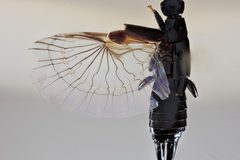
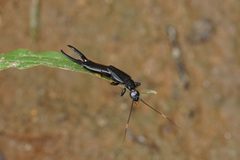
Chelisoches morio, commonly known as the black , is a earwig in the Chelisochidae. are uniformly jet black and among the largest earwigs, reaching up to 36 mm in length. The species exhibits extended maternal care, with females guarding and feeding first-instar nymphs before they disperse. Males possess distinctive widely separated, serrated that differ markedly from female . The species has been investigated as a potential agent due to its predatory habits and high consumption rates of agricultural pests.

Pronunciation
How to pronounce Chelisoches morio: /ˈkɛlɪˌsoʊkɛs ˈmɔrioʊ/
These audio files are automatically generated. While they are not always 100% accurate, they are a good starting point.
Identification
The combination of large size (up to 36 mm), uniform jet black coloration, and male with wide basal separation and serration distinguishes C. morio from most other . In the Pacific Northwest and tropical regions, it can be separated from smaller, lighter-colored forficulid earwigs by size and color alone. The male cercal structure is diagnostic for -level identification within Chelisoches where sympatric species occur. Nymphs are darker and lack fully developed forceps.
Images
Habitat
Occupies moist environments including tropical forests, Pacific islands, and damp temperate regions such as the Pacific Northwest of North America. Requires substrates with sufficient humidity for nesting. Often found in soil, leaf litter, and decaying organic matter where moisture is retained. Nests are constructed in moist substrates and lined with soil particles and coir.
Distribution
distribution with highest abundance in tropical regions, Pacific islands, and the Pacific Northwest of North America. Records span multiple continents though precise native range is obscured by widespread human-mediated . Present in both Old World and New World tropics and subtropics.
Seasonality
Active year-round in tropical ; activity patterns in temperate regions undocumented but likely seasonal. are primarily though activity has been observed. Courtship and mating can occur at any time of day.
Diet
with documented on aphids (Aphididae), leaf beetles (Chrysomelidae), hoppers, mites, mealybugs (Pseudococcidae), and . Also consumes plant material including fruits such as bananas and dragon fruits. feeding habits support its potential as a agent.
Life Cycle
Development includes four nymphal instars before . Females deposit approximately 140 per clutch in irregularly shaped nests constructed in moist substrate. Incubation lasts 5–7 days. First-instar nymphs aggregate near the mother and receive maternal feeding for one day before molting to second instar and dispersing. Third and fourth instars show increasing predatory capability, with fourth instars able to kill adult prey. Adult male lifespan averages 60 days; adult female lifespan averages 94 days.
Behavior
Nocturnally active with some activity observed. Exhibits pronounced maternal care: females construct nests, deposit in clusters, and remain with eggs throughout incubation, using mouthparts to clean, rearrange, and maintain egg moisture. Females guard eggs against disturbance; removal of the female immediately after oviposition results in egg inviability. After hatching, females feed first-instar nymphs for approximately 24 hours and protect them through the first , after which maternal care terminates and nymphs disperse.
Ecological Role
in soil and leaf litter , consuming diverse small arthropods including agricultural pests. Polyphagy and high consumption rates contribute to of prey . Maternal care enhance offspring survival in humid microhabitats. May contribute to nutrient cycling through consumption of decaying plant matter.
Human Relevance
Investigated as a agent for agricultural pests including Tirathaba rufivena, mealybugs, aphids, and leaf beetles. occurs across all larval stages of C. morio and targets multiple pest . Not known to cause damage to crops or structures; benefits appear to outweigh any minor plant feeding. No documented medical or nuisance significance.
Similar Taxa
- Forficula auricularia (European earwig)Smaller size (typically 10–16 mm), brown coloration with pale legs and , and male that are strongly curved and not widely separated at the base. Lacks the uniform jet black color and large size of C. morio.
- Euborellia spp.Different cercal structure and typically smaller size; some have reduced wings and different body proportions. Euborellia plebeja, a common species, has shorter, more curved forceps and lighter coloration.
More Details
Mating System
Males initiate courtship through antennal tapping. Receptive females reciprocate with antennal contact, cueing males to move to the side and curve the for genital contact. Unreceptive females may use to repel males. Pairs mate 2–8 times with copulation duration ranging from minutes to one hour. Males may mate with up to 6 females. Multiple matings increase female and viability.
Biological Control Potential
High prey consumption rates across all life stages and polyphagy on multiple agricultural pest make C. morio a focus of research for . Studies have examined rearing techniques, prey intake volumes, and optimization for mass production.
Sources and further reading
- BugGuide
- Wikipedia
- GBIF taxonomy match
- iNaturalist taxon
- NCBI Taxonomy
- Catalogue of Life
- Superworms: The Bigger, Brawnier, Hungrier Cousins of Yellow Mealworms
- Study Examines Insects' Role in Plastic Pollution
- Celebrating 10 years of Open Access: Deutsche Entomologische Zeitschrift | Blog
- Two New Beetle Species Identified at NEON Field Site in Hawai'i
- Sitting on top of the world | Blog
- beetle | Blog - Part 2