
Chelisoches
Scudder, 1876
Species Guides
1- Chelisoches morio(black earwig)
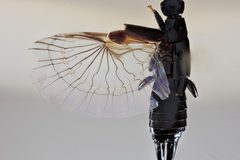
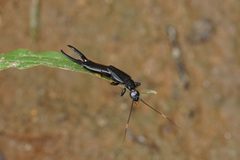
Chelisoches is a of earwigs in the Chelisochidae, native to the Pacific Islands. The genus name derives from Greek, meaning 'pincer-carrier.' The most studied , C. morio (black ), has been introduced to California and Florida and is recognized as an effective of agricultural pests including mealybugs, larvae, and stem borers. Research on C. morio has established laboratory rearing methods and documented complex parental care , including -tending and feeding assistance to hatchlings.
Pronunciation
How to pronounce Chelisoches: /ˌkiːlɪˈsoʊkiːz/
These audio files are automatically generated. While they are not always 100% accurate, they are a good starting point.
Identification
Members of Chelisoches can be distinguished from other by their placement in the Chelisochidae, characterized by specific genitalic and wing traits. C. morio is recognizable by its dark coloration and relatively large size among earwigs. Definitive identification to level requires examination of male genitalia and forceps structure.
Images
Habitat
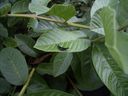
Dark, humid microhabitats; specifically observed in leaf axils and flowers of palm plants. Native occur in Pacific Island environments. Introduced of C. morio in California and Florida occupy similar sheltered, moist .
Distribution
Native to Pacific Islands including Cook Islands, Philippines, Malaysia, and tropical Queensland. C. morio specifically recorded from Southeast Asia (China, Malaysia, Philippines) and Pacific Islands; introduced and established in California and Florida, USA.
Diet
Predatory. C. morio has been documented feeding on Tirathaba rufivena larvae (first through fifth instar), mealybugs (Dysmicoccus neobrevipes), and larvae. Laboratory studies indicate consumption rates decrease with prey age: approximately 11 first-instar, 8 second-instar, 7 third-instar, 7 fourth-instar, and 6 fifth-instar T. rufivena larvae per day. Can be maintained on artificial diets including dog food and fish-based materials.
Host Associations
- Tirathaba rufivena - preyPrimary prey in studies; palm pest (Lepidoptera: Pyralidae)
- Dysmicoccus neobrevipes - preyMealybug prey used in laboratory rearing studies
- Brontispa longissima - preyReported in literature; palm pest (Coleoptera: Hispidae)
- Rhynchophorus ferrugineus - prey and young larvae reported in literature; palm pest (Coleoptera: Curculionidae)
Life Cycle
stage followed by four nymphal instars. Under laboratory conditions (26–29°C), egg incubation averages 7.5 days. Nymphal development totals approximately 58–84 days depending on diet: 70.7 days on mealybugs, 57.2 days on mealybugs plus dog food, 61.6 days on dog food alone, or 84 days on T. rufivena larvae with honey water supplementation. Individual instar durations: approximately 13, 11, 15, and 22 days respectively. longevity averages 59 days for males and 94 days for females under laboratory conditions with dietary supplementation.
Behavior
Exhibits courtship prior to mating. Pairs mate 2–8 times consecutively; males can mate with up to six females. Females display elaborate parental care: they whisk with mouthparts, rearrange or transfer eggs when disturbed, and flip eggs to facilitate heating and incubation. Eggs separated from fail to hatch. Newly hatched nymphs have limited mobility and require adult feeding assistance via mouth-to-mouth transfer; they become self-feeding after the first . Adults prefer concealed, dark, humid locations and demonstrate hiding behavior in leaf axils or flowers.
Ecological Role
of palm pest insects with significant potential as a agent. Effective against Tirathaba rufivena, with daily consumption rates sufficient for pest suppression. Proposed for use alongside in programs for palm . Laboratory mass rearing protocols have been developed to support field release programs.
Human Relevance
Used as a agent for agricultural pests, particularly in palm oil and coconut plantations. Mass rearing techniques have been developed to produce large numbers for field release. Introduced in California and Florida represent non-native establishment with unknown ecological impacts.
Similar Taxa
- ForficulaBoth are with forceps-like , but Chelisoches belongs to Chelisochidae while Forficula is in Forficulidae; distinguished by wing venation and genitalic
- EuborelliaAnother chelisochid ; -level identification and subtle morphological differences in male genitalia and forceps structure required for separation
More Details
Etymology
name derived from Greek χηλη (chēlē, 'pincer' or 'claw') and οχεω (ocheō, 'to carry'), referring to the prominent forceps-like characteristic of earwigs.
Laboratory Rearing Notes
Successful mass rearing achieved using dog food, fish fry, or combinations with mealybugs. Diet significantly affects development time: mealybug plus dog food yields shortest lifespan (52 days), while mealybug plus cornmeal yields longest (67 days). Honey water supplementation extends longevity in laboratory settings.
Sources and further reading
- BugGuide
- Wikipedia
- GBIF taxonomy match
- iNaturalist taxon
- NCBI Taxonomy
- Catalogue of Life
- Biology of the Black Earwig Chelisoches morio (fabricius) (Chelisochidae,Dermaptera)
- Rearing earwig Chelisoches morio (Fabricius) on a variety of artificial diets
- Preliminary study on biology and feeding capacity of Chelisoches morio (Fabricius) (Dermaptera:Chelisochidae) on Tirathaba rufivena (Walker)