
Coelocnemis rugulosa
Doyen, 1973
Coelocnemis rugulosa is a of darkling beetle in the Tenebrionidae, described by Doyen in 1973. It belongs to a of seven species found in western North America and adjacent southern Canada. Like other Coelocnemis species, it is a flightless, adapted to xeric forest . The genus is distinguished from the superficially similar Eleodes by having distinct parallel lines of yellow on the inner surface of the tibiae.
Pronunciation
How to pronounce Coelocnemis rugulosa: //ˌsiːloʊˈknɛmɪs ruːˈɡuːˌloʊsə//
These audio files are automatically generated. While they are not always 100% accurate, they are a good starting point.
Identification
Distinguished from Eleodes by the presence of two parallel lines of yellow on the inner surface of the tibiae (Eleodes lacks this feature). The pronotum is typically broader and more angular than in Eleodes. From other Coelocnemis , identification requires examination of more subtle characters; C. rugulosa specifically is characterized by its sculptured () , as suggested by the species epithet. Found in pine forest and oak-conifer woodland rather than barren desert .
Images
Appearance
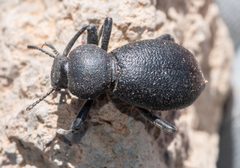
Large, robust black with and no wings. Pronotum broader and more angular than in Eleodes. Hind tibiae bear distinct parallel lines of yellow on their inner surfaces, with a groove between them (the "hollow shin" characteristic that gives the its name). Body form typical of darkling beetles: elongate, somewhat cylindrical, with elytra completely covering the .
Habitat
Pine forest and oak-conifer woodlands. Typically found in or under rotten logs. Occupies mesic to xeric forest environments in mountainous regions of western North America.
Distribution
Western United States and adjacent southern Canada. Specific records include southwestern U.S. including Utah, Arizona, and Nevada. The Coelocnemis as a whole ranges across western North America; C. rugulosa has been documented from at least Utah based on collection records.
Seasonality
active during warmer months. activity peaks during summer. One observation from September in southwestern Utah suggests late-season activity. Hibernates in small groups in dry, protected during winter.
Diet
feed on plant detritus, lichens, fungi, seeds, and related organic matter.
Life Cycle
Larvae resemble large , armed at the rear with a pair of hook-like prongs and smaller teeth behind them. Larval development occurs in decaying wood and organic matter. are long-lived, surviving at least three years.
Behavior
Nocturnally active, wandering at night to avoid desiccation and overheating. Performs defensive "headstand" when threatened, raising the and secreting defensive chemicals from glands at the tip. Defensive secretions are smelly and effectively repel most vertebrate . Hibernates in small groups in dry, protected locations.
Ecological Role
Contributes to decomposition of plant detritus and nutrient cycling in forest . Serves as prey for specialized such as mice, which have evolved techniques to disarm the beetles by jamming the into the ground before consuming the and .
Human Relevance
No significant direct human relevance. Not a pest . May be encountered by entomologists and naturalists in western North American forests.
Similar Taxa
- EleodesSuperficially similar large black darkling beetles, but Eleodes lacks the parallel lines of yellow on the inner tibial surface and typically has a narrower, less angular pronotum. Eleodes is more characteristic of barren desert rather than pine-oak woodlands.
- Coelocnemis sulcataCongeneric with similar preferences (pine forest habitats, found on trunks of Pinus ponderosa), distinguished by elytral and other subtle morphological differences.
- ZopherusAnother large black found on pine trunks at night in similar , but belongs to Zopheridae (ironclad beetles) and has different body form and defensive strategies.
Misconceptions
Commonly mistaken for Eleodes by casual observers due to similar large black appearance and defensive headstand . The name Coelocnemis is often misspelled or confused with Coelocnemus (an error seen even in some field notes).
More Details
Etymology
The name Coelocnemis derives from Greek "koilos" (hollow) and "kneme" (shin), referring to the groove between the lines of hairs on the tibia. The epithet rugulosa refers to the wrinkled or sculptured nature of the .
Conservation status
No specific conservation status assessed; appears to be uncommon to rare based on limited collection records (21 observations on iNaturalist as of source date).