
Coelocnemis
Mannerheim, 1843
darkling beetles, broad-necked darkling beetles
Species Guides
6- Coelocnemis dilaticollis(California Broad-necked Darkling Beetle)
- Coelocnemis lucia
- Coelocnemis magna
- Coelocnemis punctata
- Coelocnemis rugulosa
- Coelocnemis sulcata
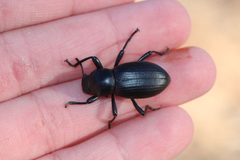
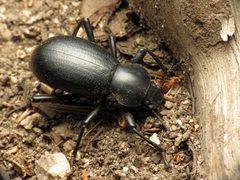
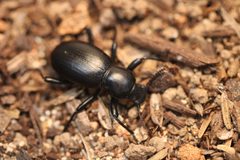
Coelocnemis is a of darkling beetles in the Tenebrionidae, containing approximately seven described distributed across western North America. These large, flightless beetles are primarily associated with coniferous forest , particularly pine and oak-conifer woodlands, where they are active nocturnally. The genus is distinguished from superficially similar darkling beetles by distinctive morphological features, including parallel lines of yellow on the inner tibial surfaces.
Pronunciation
How to pronounce Coelocnemis: //sɛɪloʊˈnɛˌmɪs//
These audio files are automatically generated. While they are not always 100% accurate, they are a good starting point.
Identification
Coelocnemis is most frequently confused with Eleodes, another of large black darkling beetles. The definitive distinguishing character is the presence of distinct, parallel lines of yellow on the inner surface of the tibiae in Coelocnemis, which Eleodes lacks. The pronotum of Coelocnemis is typically broader and more angular than that of Eleodes. provides additional clues: Coelocnemis is strongly associated with pine forests and oak-conifer woodlands, while Eleodes is more characteristic of open, barren desert . Both genera exhibit similar defensive headstand and chemical defense, so behavior alone cannot distinguish them.
Images
Habitat
Primarily coniferous forest , especially Ponderosa pine (Pinus ponderosa) forests and oak-conifer woodlands. Frequently found in or under rotten logs, on tree trunks at night, and in pine duff. Occurs from low-elevation pine woodlands to alpine coniferous forests, typically in xeric to semi-mesic conditions within forested environments.
Distribution
Western North America: western Canada (British Columbia, Alberta), western United States (Washington, Oregon, California, Nevada, Utah, Arizona, New Mexico, Colorado, Idaho, Montana, Wyoming), and Mexico. Easternmost records extend to the western Great Plains in isolated woodland .
Seasonality
active primarily from late spring through early fall, with peak activity in summer months. activity increases during warmer periods. Adults hibernate in small groups in dry, protected during winter. Observations span June through September in field studies, with reduced activity in late September at higher elevations.
Diet
feed on plant detritus, lichens, fungi, seeds, and related organic matter. Larvae likely feed on decaying organic matter, though specific dietary details for Coelocnemis larvae are not well documented.
Life Cycle
Complete with , larval, pupal, and stages. Larvae resemble large , armed at the with a pair of hook-like prongs and smaller teeth behind them. Adults are long-lived, surviving at least three years. occurs as adults in small in dry, protected locations.
Behavior
Nocturnally active, wandering on tree trunks and ground surfaces during cool night hours to avoid desiccation and overheating. Exhibits defensive 'headstand' posture when threatened, elevating end to present chemical defense glands. Secretes smelly defensive chemicals from abdominal glands to repel . Flightless due to and reduced wings.
Ecological Role
Decomposer contributing to nutrient cycling in forest through consumption of plant detritus, fungi, and decaying organic matter. Serves as prey for specialized such as mice (Onychomys), which have evolved to disarm chemically defended beetles. Component of forest floor and trunk-dwelling .
Human Relevance
Occasionally encountered by campers and hikers in western pine forests; defensive headstand and chemical secretions make them memorable but harmless if handled carefully. Not an agricultural or structural pest. Sometimes mistaken for Eleodes by casual observers.
Similar Taxa
- EleodesLarge black darkling beetles with similar body form and defensive headstand ; distinguished by lack of yellow pubescent lines on tibiae and preference for more open, barren desert versus forest environments.
More Details
Etymology
The name 'Coelocnemis' translates approximately to 'hollow shin,' referring to the groove between the parallel lines of yellow on the inner tibial surfaces.
Defensive Adaptations
Like many tenebrionid beetles, Coelocnemis has evolved convergently with Eleodes in defensive and , including the headstand posture and chemical defense glands, representing independent evolution of similar anti- strategies.
Collection Notes
Most reliably collected by night-searching tree trunks of Ponderosa pine and other conifers with a flashlight or headlamp; also found under bark and in rotten logs. Mating pairs have been observed on tree trunks at night.