
Lecontia discicollis
(LeConte, 1850)
Burnt Conifer Bark Beetle
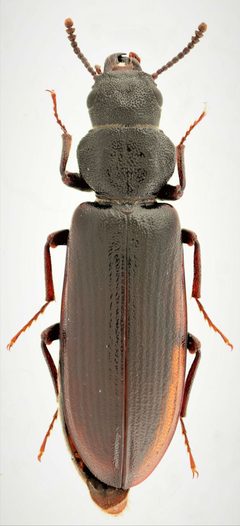
Lecontia discicollis is a distinctive conifer bark beetle in the Boridae, the sole member of its in North America. It is a slow-moving, jet black with a convex, bullet-like shape and bead-like . The is strongly associated with fire-killed conifers, particularly ponderosa pine, where and larvae occupy a narrow in moist, white-rotted wood near and below ground level. Despite being locally common in suitable , it is rarely encountered due to its specialized requirements.
Pronunciation
How to pronounce Lecontia discicollis: /lɛˈkɒn.ti.ə ˌdɪs.ɪˈkɒl.ɪs/
These audio files are automatically generated. While they are not always 100% accurate, they are a good starting point.
Identification
Distinguished from superficially similar beetles by its combination of jet black, non-metallic coloration; convex, bullet-like body shape; slow, deliberate movement; and bead-like () with bases concealed by a ridge. Unlike bark-gnawing beetles (Trogossitidae), it lacks iridescence and agility. Unlike darkling beetles (Tenebrionidae), it has a notably narrow body and exposed jaws. The single North American , Boros unicolor, is more elongate and occurs in different microhabitats.
Images
Habitat
Fire-killed conifer forests, specifically standing trees killed by fire or bark beetles. and larvae occupy moist, white-rotted wood in the root system and lower trunk, typically 3–5 years after tree death. Associated with ponderosa pine in the Black Hills and southwestern U.S., and found at elevations ranging from approximately 7000–8300 ft in montane forests.
Distribution
North America: documented from the Black Hills of South Dakota, Colorado (Front Range), and the southwestern U.S. including northern Arizona (Coconino County, Kaibab National Forest) and southern Utah. Central American records also reported. In Canada, recorded from Alberta.
Seasonality
have been observed in April and June, suggesting spring to early summer activity. observed on tree trunks.
Host Associations
- Pinus ponderosa - breeding substratefire-killed trees, moist decayed root system and lower trunk
Life Cycle
Larvae develop in moist, white-rotted wood near and below ground level in standing fire-killed conifers. Developmental timing poorly documented, but association with trees 3–5 years post-fire suggests a multi-year .
Behavior
Slow-moving and deliberate in locomotion. Nocturnally active on trunks of fire-killed or stressed conifers. have been observed searching tree trunks at night, sometimes in association with other beetles.
Ecological Role
Decomposer in fire-killed conifer ; contributes to wood decay processes in standing dead trees. Specialized occupant of a narrow, extreme that few other beetles exploit.
Human Relevance
Of interest to coleopterists due to rarity of encounter and specialized requirements. Not a forest pest; poses no economic threat to timber or living trees.
Similar Taxa
- Boros unicolorOnly other North American borid ; more elongate body form, different microhabitat preferences
- TrogossitidaeBark-gnawing beetles share association with dead wood but are agile, often metallic or iridescent, with different antennal structure
- TenebrionidaeSome darkling beetles have bead-like but lack the convex, bullet-shaped body and exposed jaws; generally broader-bodied