
Trogossitidae
Latreille, 1802
bark-gnawing beetles
Genus Guides
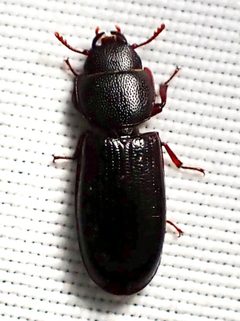
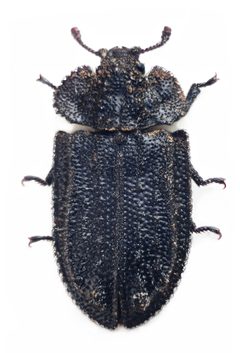
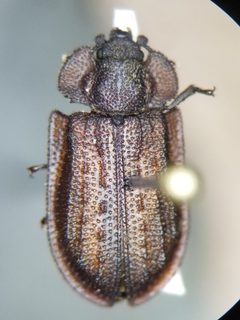
2Trogossitidae is a small of beetles in the superfamily Cleroidea, commonly known as bark-gnawing beetles. The family has undergone significant taxonomic revision, with many former members reassigned to separate families (Lophocateridae, Peltidae, Protopeltidae, Rentoniidae, and Thymalidae) as of 2019. Under the modern circumscription, the family contains approximately 400 in 25 , reduced from roughly 600 species in over 50 genera under previous definitions. Members are predominantly predatory and/or mycophagous, with both and larvae associated with wood .
Pronunciation
How to pronounce Trogossitidae: //ˌtrɒɡəˈsɪtɪdiː//
These audio files are automatically generated. While they are not always 100% accurate, they are a good starting point.
Identification
Trogossitidae are distinguished from related by their association with wood and their characteristic predatory or fungivorous habits. Members can be separated from the now-segregated families Lophocateridae, Peltidae, and others by the restricted modern definition of Trogossitidae following the 2019 taxonomic revisions. Specific identification to or level requires examination of morphological characters including structure, body form, and other detailed features.
Images
Habitat
Associated with wood substrates, including under bark and inside bored tunnel galleries in trees. Some are attracted to fire-killed or recently dead conifers, with specific preferences for trees 3–5 years post-fire.
Distribution
distribution with approximately 59 in the Americas and 36 in Australia. The oldest fossil assignable to the modern definition is Microtrogossita from mid-Cretaceous Burmese amber of Myanmar, indicating considerable diversification by that time.
Diet
Predatory on other insects and/or fungivorous, feeding on fungi. Some are specialized of bark beetles (Scolytinae), with documented prey including Pityogenes chalcographus and Taphrorychus bicolor.
Life Cycle
Complete with larval stages developing in wood. Larvae of some are restricted to moist decayed areas in the root systems of standing trees killed by fire or bark beetles.
Behavior
Some respond to of their bark beetle prey, making them attracted to artificial lures targeting pest species. and larvae are generally slow-moving compared to some related .
Ecological Role
of bark beetles and other wood-associated insects, potentially contributing to of forest pests. Their response to prey suggests they may be drawn to areas of high pest .
Human Relevance
Some are inadvertently captured in traps targeting bark beetle pests, which could affect monitoring . Their potential as agents for bark beetles has been suggested but requires further study.
Similar Taxa
- LophocateridaeFormerly included within Trogossitidae but separated in 2019 taxonomic revision; distinguished by different morphological and presumably biological characteristics
- PeltidaeFormerly included within Trogossitidae but now recognized as separate ; includes such as Peltis
- CleridaeRelated within Cleroidea with similar predatory habits but distinguished by morphological features and different associations
Sources and further reading
- BugGuide
- Wikipedia
- GBIF taxonomy match
- iNaturalist taxon
- NCBI Taxonomy
- Catalogue of Life
- Bug Eric: Borids Are Not Bor-ing
- Eumastacidae | Beetles In The Bush
- Nemozoma gymnosternalis sp. nov., a new anomalous species of Trogossitidae from Brazil
- A New Species of Nemozoma Latreille, 1804 (Coleoptera: Cleroidea: Trogossitidae) from the French Antilles and New Distributional Records for Nemozoma fleutiauxi Lepesme, 1947
- A description of a larva of Ancyrona diversa Pic, 1921 and its phylogenetic implications (Coleoptera: Trogossitidae)
- Distribution of the flat bug Aradus obtectus (Hemiptera: Heteroptera: Aradidae) and the bark-gnawing beetle Peltis grossa (Coleoptera: Trogossitidae) in the Czech Republic and their first records in the White Carpathians
- The Bark-Gnawing Beetles of Montana, USA (Coleoptera: Trogossitidae, Peltidae, and Lophocateridae), Including New Substantial Distributional Records for Tenebroides collaris (Sturm)
- Studies on the Biology and Distribution of Cadelle, Tenebroides mauritanicus (L.) (Coleoptera: Trogossitidae) in Bursa, Turkey
- Le point sur la répartition de Peltis ferruginea (Linnaeus, 1758) (Coleoptera, Trogossitidae) en France continentale
- Observations on the Life History ofNemozoma championi(Wickham) (Coleoptera: Trogossitidae)
- The relationship between Nemozoma elongatum (Coleoptera: Trogossitidae) and its primary bark-beetle prey-species