
Lophocateridae
Crowson, 1964
Genus Guides
4- Eronyxa
- Grynocharis(bark-gnawing beetles)
- Lophocateres
- Lycoptis
Lophocateridae is a small of cleroid beetles comprising over 100 in 14+ . Formerly treated as a or tribe of Trogossitidae, molecular phylogenetic analyses led to its elevation to family rank in 2019. The family is recovered as sister to Chaetosomatidae and Trogossitidae sensu stricto. Extant species occupy diverse including , herbivory, and , primarily in association with dead wood . The family has a fossil record extending to the Early Cretaceous.
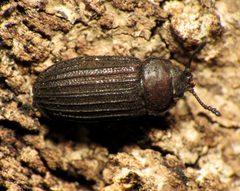
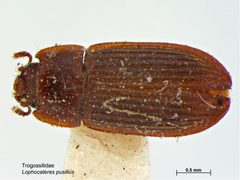
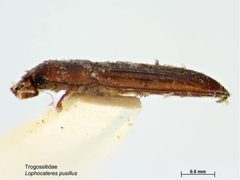
Pronunciation
How to pronounce Lophocateridae: /ˌloʊ.foʊ.kəˈtɛr.ɪˌdiː/
These audio files are automatically generated. While they are not always 100% accurate, they are a good starting point.
Identification
Separation from Trogossitidae sensu stricto requires molecular or detailed morphological analysis; the was historically included within Trogossitidae. Carinicateres merkli is distinguished by tarsal formula 4-4-4, with 2 complete and 3 incomplete carinae, and 10-segmented with 2-segmented club. Some specimens historically identified as Lophocateres have been reidentified as belonging to the clade Ancyrona + Neaspis.
Images
Habitat
Saproxylic ; primarily associated with dead wood. Natural forest habitats in regions where established.
Distribution
distribution. Poland: single accidental introduction record of Lophocateres pusillus, not established in natural . Montana, USA: present (specific records not detailed in available sources). Thailand: at least one described (Carinicateres merkli). Fossil record from Burmese amber (Myanmar, Cenomanian) and Laiyang Formation (China, Aptian).
Diet
Diverse feeding habits including , herbivory, and of other insects. Specific dietary preferences vary among and .
Human Relevance
Lophocateres pusillus recorded as accidental introduction to Poland, but not established; significance of this introduction unclear. Some may be incidentally associated with stored products or human-modified environments.
Similar Taxa
- TrogossitidaeHistorically included within Trogossitidae; separated based on molecular phylogenetic analyses showing Trogossitidae sensu lato was not monophyletic. Lophocateridae now treated as sister group to Chaetosomatidae and Trogossitidae sensu stricto.
- ChaetosomatidaeSister to Lophocateridae in recent phylogenetic analyses; both share common ancestry distinct from Trogossitidae sensu stricto.
Misconceptions
The was long treated as a or tribe of Trogossitidae; only elevated to family rank following molecular studies in 2014-2019. Some specimens used in molecular were misidentified as Lophocateres when they actually belonged to Neaspis.
More Details
Taxonomic History
Originally described by Crowson in 1964 as a group within Trogossitidae. Elevated to status by Gimmel et al. (2019) based on comprehensive molecular phylogenetic analysis of Cleroidea.
Fossil Record
Three fossil known: †Sinosoronia (Early Cretaceous, China), †Mesolophocateres and †Parayixianteres (Late Cretaceous Burmese amber, Myanmar), plus †Zaiwa (mid-Cretaceous Burmese amber). These extend the 's temporal range to at least the Aptian (~125-113 million years ago).
Sources and further reading
- BugGuide
- Wikipedia
- GBIF taxonomy match
- iNaturalist taxon
- NCBI Taxonomy
- Catalogue of Life
- Trogossitidae, Lophocateridae, Peltidae and Thymalidae (Coleoptera: Cleroidea) of Poland: distribution, biology and conservation
- Zaiwa: A new genus of the family Lophocateridae from mid-Cretaceous Burmese amber (Coleoptera: Cleroidea)
- The Bark-Gnawing Beetles of Montana, USA (Coleoptera: Trogossitidae, Peltidae, and Lophocateridae), Including New Substantial Distributional Records for Tenebroides collaris (Sturm)
- Carinicateres merkli gen. et sp. nov. from Thailand, with notes on identification of two lophocateride beetles used in recent molecular phylogenies (Cleroidea, Lophocateridae)
- A New Genus and Species of Lophocateridae from Mid-Cretaceous Amber of Myanmar (Coleoptera).