
Lecontia
W. Cooper
conifer bark beetles
Species Guides
1- Lecontia discicollis(Burnt Conifer Bark Beetle)
Lecontia is a of conifer bark beetles in the Boridae, containing a single , Lecontia discicollis. These beetles are found in Central America and North America, where they inhabit the bark of dead conifers. The genus is notable for its specialized association with fire-killed or stressed conifer trees, particularly in the years following forest fires.
Pronunciation
How to pronounce Lecontia: //lɪˈkɒntiə//
These audio files are automatically generated. While they are not always 100% accurate, they are a good starting point.
Identification
Lecontia can be distinguished from similar darkling beetles (Tenebrionidae) by its narrow body form and exposed jaws. It differs from bark-gnawing beetles (Trogossitidae) by its lack of iridescence, slower movement, and non-agile . The concealed antennal bases serve as a key diagnostic character. The contains only one in North America north of Mexico, making species-level identification straightforward within this range.
Images
Appearance
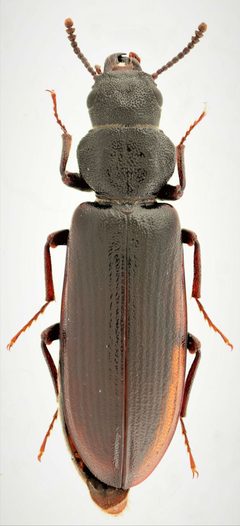
Lecontia discicollis measures 12-23 mm in length. The body is shiny black with a convex, bullet-like shape. The base of the is concealed by a ridge. The body is narrow and somewhat elongated, with exposed jaws visible from above.
Habitat
Found under the bark of dead conifers, particularly in moist, decayed areas of the root system of standing trees killed by fire or bark beetles. Strongly associated with burned timber, typically 3-5 years post-fire. Larval appears restricted to soft, moist, white-rotted wood near and below ground level in fire-killed trees.
Distribution
Central America and North America. Documented from the southwestern United States including Arizona, Utah, Nevada, and Colorado, with records from the Black Hills of South Dakota in fire-killed ponderosa pine.
Seasonality
have been observed in June. Activity likely coincides with the post-fire window of 3-5 years when trees provide suitable moist, decayed wood conditions.
Host Associations
- Pinus ponderosa - Fire-killed trees, 3-5 years post-death
- Juniperus osteosperma - Dead or stressed trees
- Pinus monophylla - Fallen branches and dead trees
- Pinus edulis - Recently dead trees
Life Cycle
Larvae develop in moist, decayed, white-rotted wood near and below ground level in standing conifers killed by fire or bark beetles. The specific developmental stages and duration remain undocumented.
Behavior
are slow-moving and , found crawling on tree trunks at night. They appear to be attracted to stressed or recently dead conifers. Adults have been observed on tree trunks in full sunlight during daytime, suggesting some activity.
Ecological Role
Appears to function as a decomposer in post-fire forest , utilizing dead conifer wood in advanced stages of decay. The specific ecological role remains poorly documented due to limited study.
Human Relevance
No known economic or medical significance. Not considered a forest pest. Of interest to coleopterists due to its specialized requirements and relative obscurity.
Similar Taxa
- TrogossitidaeSimilar bark-associated habit, but Trogossitidae are highly agile, often iridescent or metallic, and more active
- TenebrionidaeSimilar bead-like and dark coloration, but Tenebrionidae typically have broader bodies and lack the concealed antennal bases
- SalpingidaeHistorically classified together; Boridae was previously treated as part of Salpingidae (narrow-waisted bark beetles)
More Details
Taxonomic history
The Boridae was previously treated as part of Salpingidae (narrow-waisted bark beetles). The family remains poorly studied, with several major reference works omitting it entirely or containing outdated classifications.
Niche specialization
Despite potentially being locally common, Lecontia occupies such a narrow, extreme (fire-killed conifer root systems) that encounters are infrequent. This specialization explains the scarcity of records relative to the apparent abundance in suitable .