
Omorgus scutellaris
(Say, 1824)
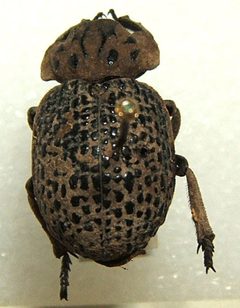
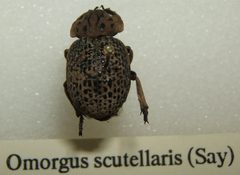
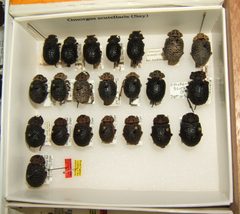
Omorgus scutellaris is a of hide beetle in the Trogidae. It occurs in the south-central United States and northern Mexico. Like other trogids, it is associated with decomposing animal matter. The species has been documented from sand dune in Texas and is attracted to ultraviolet light.
Pronunciation
How to pronounce Omorgus scutellaris: /oʊˈmɔrɡəs ˌskjuːtəˈlɛrɪs/
These audio files are automatically generated. While they are not always 100% accurate, they are a good starting point.
Identification
Distinguished from other Trogidae by genitalia and specific tuberculation patterns on the scutellum and . Omorgus generally differ from the related Trox by having the scutellum visible and not covered by the pronotum. Specific identification of O. scutellaris requires examination of male genitalia and comparison with related species such as O. nodosus and O. suberosus.
Images
Appearance
Habitat
Documented from sand dune systems in western Texas, including the Mescalero Sand Dunes. Has been collected at ultraviolet light stations in open dune areas with mixed vegetation including mesquite and shin oak. The occurs in arid and semi-arid environments.
Distribution
United States: Kansas, Missouri, and Texas. Mexico: Chihuahua, Coahuila, Distrito Federal, Durango, Morelos, Nuevo León, Puebla, and Sonora.
Seasonality
have been collected in late April and early May in Texas. Activity appears to be , with specimens attracted to ultraviolet light after dusk.
Behavior
Nocturnally active; have been observed on sand at night and are attracted to ultraviolet light. One observation records an individual feeding on dried dog , suggesting scavenging on animal matter.
Ecological Role
As a member of Trogidae, this likely functions as a scavenger and decomposer of animal remains, contributing to nutrient cycling in arid . The is commonly known as hide beetles due to their association with dried animal skins and carcasses.
Human Relevance
Has been collected during entomological surveys and blacklighting studies. No known economic or medical significance.
Similar Taxa
- Omorgus nodosusAlso occurs in sandy of the southwestern United States and is attracted to lights; distinguished by differences in pronotal and scutellar tuberculation.
- Omorgus suberosusOverlapping distribution in Texas and Mexico; similar size and dark coloration; requires examination of male genitalia for definitive separation.
- Trox spp.Related in the same ; generally larger with the scutellum covered by the pronotum, unlike Omorgus where the scutellum is visible.
More Details
Collecting methods
Successfully collected using ultraviolet light stations placed in open dune areas. walk on sand at night and can also be found by searching ground surfaces with headlamps.