
Valgus hemipterus
(Linnaeus, 1758)
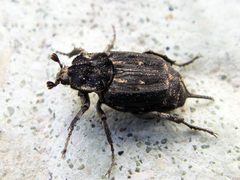
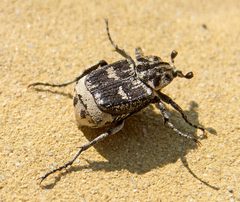
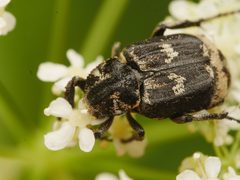
Valgus hemipterus is a small scarab beetle in the Cetoniinae, measuring 6–10 mm in length. The is notable for pronounced : females possess an elongated, acuminate with a central groove and lateral serrations, a trait unusual among beetles, while males exhibit a different pattern and are more frequently observed on flowers. It has one per year and overwinters as a pupa.
Pronunciation
How to pronounce Valgus hemipterus: /ˈvælɡəs ˌhɛmɪpˈtɪərəs/
These audio files are automatically generated. While they are not always 100% accurate, they are a good starting point.
Identification
Distinguished from similar Valgus by the female's elongated, grooved and the species-specific patterns. The shortened and overall small size separate it from larger Cetoniinae. Males may be confused with other small flower-visiting scarabs but differ in scale arrangement and body shape.
Images
Habitat
Found in diverse including vineyards, urban areas, and woodlands. Associated with moist, rotting wood of broadleaf trees for larval development. occur on flowers of various shrubs and on the ground near decaying wood.
Distribution
Native range spans from the Caucasus and Turkey through North Africa and across southern and central Europe. Introduced to the , established in parts of North America including Ontario, Michigan, and Ohio.
Seasonality
active from early April to August. Peak mating activity occurs from mid-May to late June. Larval development occurs through summer, with by mid-autumn.
Diet
visit flowers; males feed on nectar using brush-like mouthparts. Larvae feed internally in moist, rotting wood of broadleaf trees including oak, linden, elder, willow, elm, Robinia, and chestnut.
Host Associations
- Quercus - larval foodoak
- Tilia - larval foodlinden
- Sambucus - larval foodelder
- Salix - larval foodwillow
- Ulmus - larval foodelm
- Robinia - larval foodblack locust
- Castanea - larval foodchestnut
Life Cycle
(one per year). laid in moist rotting wood from mid-May to late June; female uses to prepare oviposition site. Egg incubation approximately 18 days. Three larval instars: first instar ~22–28 days, second instar ~19 days, third instar grows to 17 mm maximum. occurs in wood or soil beneath by mid-autumn, with pupal stage lasting ~15 days. Overwinters as pupa.
Behavior
Males visit flowers for nectar; females more often walk on ground seeking mates or oviposition sites. Courtship involves male climbing and licking female's entire body for approximately ten minutes; multiple mating attempts often unsuccessful. Mating occurs inside dark cavities of wood, lasting about one hour. Swarming observed in late May and early June. Most active on warm, cloudy days or with partial sunshine.
Ecological Role
contribute to pollination through flower visitation. Larvae are wood decomposers, processing decaying broadleaf wood and contributing to nutrient cycling in forest .
Human Relevance
Generally harmless; occasional presence in urban areas and vineyards. No known economic damage or benefit. Subject of entomological interest due to unusual female and mating .
Similar Taxa
- Valgus canaliculatusSimilar small size and flower-visiting habit in males; differs in distribution (primarily Nearctic) and association with galleries in New World
- Other CetoniinaeLarger body size, complete covering , and lack of pronounced in structure
More Details
Mating system peculiarities
The exhibits an unusual mating system where the male must attach from below and grasp the female because her elongated ovipositor () physically interferes with conventional mounting positions. This structural constraint has shaped the species' mating .
Larval development sensitivity
Larvae develop most rapidly in summer heat and prefer drier substrates with higher temperatures for optimal development, unusual among wood-boring scarab larvae which typically favor moist conditions throughout development.
Sources and further reading
- BugGuide
- Wikipedia
- GBIF taxonomy match
- iNaturalist taxon
- NCBI Taxonomy
- Catalogue of Life
- Sunday scarab: Phileurus valgus | Beetles In The Bush
- Research Confirms First Bed Bug Infestation in Costa Rica in Over 20 Years
- Spring beetles on Coreopsis flowers | Beetles In The Bush
- Some "Green" Oils Can Stop a Bed Bug—But Many Can't
- Why Bananas and Sand Will Improve Response to an Invasive Beetle