
Trigonopeltastes delta
(Forster, 1771)
delta flower scarab, D beetle
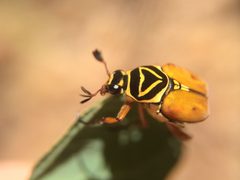
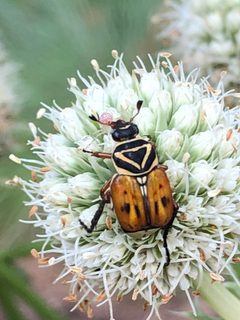
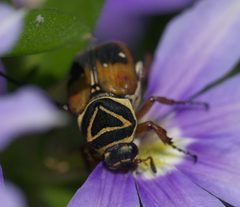
Trigonopeltastes delta is a scarab beetle in the Cetoniinae, commonly known as the delta flower scarab or D . measure 8–10 mm in length and are distinguished by a prominent yellow triangle on the pronotum that resembles the Greek letter delta, giving the its name. This marking has been theorized to function in of defensive coloration. The beetle is native to the southeastern United States with range extending north to New Jersey, and is frequently observed on flowers from late spring through summer.
Pronunciation
How to pronounce Trigonopeltastes delta: /ˌtraɪɡənoʊˈpɛltæstiːz ˈdɛltə/
These audio files are automatically generated. While they are not always 100% accurate, they are a good starting point.
Identification
are readily identified by the distinctive yellow or white triangular marking on the pronotum, shaped like the Greek letter delta. The are typically orange and black. The name refers to the triangular, shield-shaped pronotum (Greek trigon = triangle, pelt = shield). When disturbed, adults raise their hind legs above the , which together with the large white triangular creates a resemblance to a 's and .
Images
Habitat
Open areas with flowering vegetation; found on flowers in fields, meadows, and woodland edges.
Distribution
Native to the southeastern United States; range extends from the Deep South northward to New Jersey. Documented from Alabama, Arkansas, Florida, Georgia, Kansas, Kentucky, Maryland, Mississippi, Missouri, New Jersey, North Carolina, Ohio, Oklahoma, Pennsylvania, South Carolina, Tennessee, and Texas.
Seasonality
Active from late spring through summer; most commonly encountered during this period.
Diet
feed on pollen. The Cetoniinae generally feeds on decomposing fruits or pollen.
Life Cycle
Details of the remain poorly studied. Larval and development are not well documented in available sources.
Behavior
. frequent flowers and have been recorded on at least 13 different plant . When disturbed, they adopt a defensive posture with hind legs raised above the , which combined with the white triangular creates a - or -mimicking appearance. Mass numbering in the thousands have been observed on inflorescences of Sabal palm (Sabal palmetto) in Florida.
Ecological Role
Flower visitor; likely contributes to pollination of various flowering plants.
Similar Taxa
- Megacyllene decora (amorpha borer)Both are black-and-yellow beetles found on goldenrod flowers in fall; however, M. decora is a cerambycid (longhorned beetle), larger and chunkier with more boldly marked patterns, and less commonly encountered due to restricted larval plant requirements.
- Megacyllene robiniae (locust borer)Similar black-and-yellow coloration and flower-visiting on goldenrod, but a cerambycid with different body shape and structure.
- Chauliognathus pensylvanicus (goldenrod soldier beetle)Black-and-yellow insect abundant on goldenrod flowers in fall; a cantharid chemically protected by , potentially serving as a model for mimicry complexes.
Sources and further reading
- BugGuide
- Wikipedia
- GBIF taxonomy match
- iNaturalist taxon
- NCBI Taxonomy
- Catalogue of Life
- Emily Bick: Salinity, the Water Hyacinth and a Weevil | Bug Squad
- Amorpha borer on goldenrod | Beetles In The Bush
- Missouri | Beetles In The Bush | Page 9
- predator avoidance | Beetles In The Bush
- Scarabaeidae | Beetles In The Bush | Page 3
- crypsis | Beetles In The Bush
- Delta Flower Beetle Trigonopeltastes delta (Forster 1771) (Insecta: Coleoptera: Scarabaeidae : Cetoniinae : Tribe, Trichiini)