
Trichiini
Fleming, 1821
Bee Beetles and Flower Scarabs
Genus Guides
3- Gnorimella(maculate flower scarab)
- Trichiotinus(Bee-like Flower Scarabs)
- Trigonopeltastes
Trichiini is a tribe of scarab beetles within the Cetoniinae (Scarabaeidae), historically treated as a subfamily (Trichiinae). Members range from 6 to 65 mm and include the conspicuous European beetles ( Trichius). The tribe comprises five subtribes: Cryptodontina, Incaina, Osmodermatina, Platygeniina, and Trichiina. are primarily flower-associated, feeding on sugar-rich plant secretions, while most larvae develop in rotten wood or decaying organic matter.
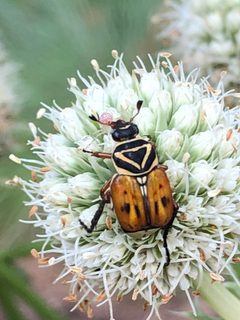
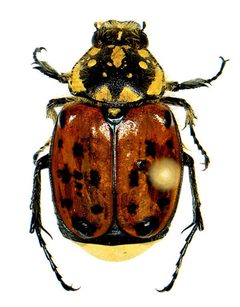
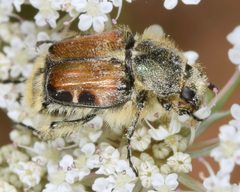
Pronunciation
How to pronounce Trichiini: //ˈtrɪki.aɪnaɪ//
These audio files are automatically generated. While they are not always 100% accurate, they are a good starting point.
Identification
Distinguished from the related tribe Cetoniini by having covered epimeres and lateral edges of the that are not trimmed.
Images
Habitat
Diverse; includes forested areas, riverine and afromontane forest pockets, mountain grasslands at high altitudes, and Fynbos vegetation in the Western Cape of South Africa. Larval microhabitats vary by : some develop inside old tree trunks and branches, others under stones or rock crevices, or in association with decomposing organic matter.
Distribution
distribution with strong representation in the Palearctic, Afrotropical, and Nearctic regions. Notable concentrations include Europe (best-known fauna), South Africa (Western Cape in such as Stegopterus; broader distribution in Stripsipher across Eastern Cape, KwaZulu-Natal, Mpumalanga, Gauteng, North-West, Limpopo, Free State, Western Cape, plus Lesotho and Swaziland), and North America (e.g., Trigonopeltastes).
Seasonality
activity generally peaks during warmer months. In South African , occurs from late October through March, with December–January peaks for high-altitude grassland species.
Diet
feed on sugar-rich secretions from stems, leaves, fruits, and flowers of various plants; some are nectar feeders from specific flowers including Buddleja saligna, Syzygium cordatum, Dalbergia obovata, Dalbergia armata, and Protea caffra. Larvae develop in rotten wood, decaying soft wood, decomposing grass litter, or herbivore (particularly Rock hyrax pellets in some species).
Life Cycle
Larvae of most develop in rotten wood or decaying plant matter. Larval development sites include old tree trunks and branches (often wood already partly consumed by other saproxylic species), under stones, or in rock crevices. Some larvae are suspended in air or avoid ground contact to reduce risk. emerge in late spring to summer depending on species and elevation. Laboratory rearing of some species has achieved approximately 80% success rate.
Behavior
are flower-frequenting and . Some fly in dense forests around decomposing wood during the hottest part of day, or crawl on dead trunks and branches. Others fly low above ground (10–50 cm) or rest on grasses. Some adult groups do not feed. Larvae of some species specifically avoid dying or recently dead wood, preferring wood already partially decomposed by other organisms.
Ecological Role
Saproxylic contribute to wood decomposition and nutrient cycling in forest . Some species participate in high-altitude grassland associated with mammal . As flower visitors, may contribute to pollination of their nectar sources.
Human Relevance
Generally considered beneficial or benign; no significant economic pest status documented. Some are conspicuous and well-known to naturalists, particularly the beetles (Trichius) in Europe. Potential economic importance of most species remains poorly studied.
Similar Taxa
- CetoniiniDistinguished by exposed epimeres and trimmed lateral edges of ; Trichiini have covered epimeres and untrimmed elytral edges.
Sources and further reading
- BugGuide
- Wikipedia
- iNaturalist taxon
- Catalogue of Life
- Delta Flower Beetle Trigonopeltastes delta (Forster 1771) (Insecta: Coleoptera: Scarabaeidae : Cetoniinae : Tribe, Trichiini)
- Revision of the Western Cape endemic genus Stegopterus Burmeister & Schaum, 1840 (Coleoptera, Scarabaeidae, Cetoniinae, Trichiini)
- Immature stages and ecology of two species of the South African genus Stripsipher Gory & Percheron, 1833 (Coleoptera, Scarabaeidae, Cetoniinae, Trichiini)
- Description and ecology of a new species of Eriopeltastes Burmeister & Schaum, 1840 (Coleoptera: Scarabaeidae: Cetoniinae: Trichiini), from KwaZulu-Natal, South Africa
- Description of three new species of Paratrichius Janson, 1881 from China and revision of the distribution range of Paratrichius rubrodecoratus (Tesař, 1952) (Coleoptera: Scarabaeidae: Cetoniinae: Trichiini)