
Trigonopeltastes
Burmeister & Schaum, 1840
Species Guides
2- Trigonopeltastes delta(delta flower scarab)
- Trigonopeltastes floridanus
Trigonopeltastes is a of fruit and flower chafers in the Scarabaeidae, containing more than 20 described distributed across North and Central America. The genus name derives from Greek 'trigon' (triangle) and 'pelt' (shield), referring to the triangular, shield-shaped pronotum characteristic of these beetles. The most commonly encountered species, Trigonopeltastes delta, is notable for its distinctive coloration and flower-visiting .
Pronunciation
How to pronounce Trigonopeltastes: //ˌtraɪɡənoʊˌpɛlˈtæstiːz//
These audio files are automatically generated. While they are not always 100% accurate, they are a good starting point.
Identification
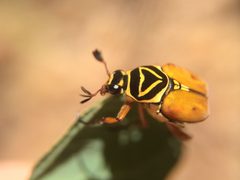
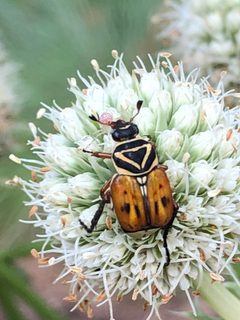
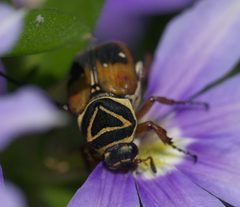
The combination of a triangular, shield-shaped pronotum with a white delta-shaped marking, orange-and-black , and a large white triangular distinguishes T. delta from similar flower-visiting scarabs. The long hind legs, often held raised when disturbed, further aid recognition. When raised, the hind legs resemble , a defensive posture unique to this group.
Images
Appearance
Beetles in this possess a triangular, shield-shaped pronotum that gives the genus its name. The pronotum typically bears distinctive markings, most notably a white triangular patch in T. delta that resembles the Greek letter delta (Δ). The are often orange and black, creating a striking color pattern. The is large, white, and triangular. Body size is relatively small compared to the they appear to mimic. The hind legs are notably long and capable of being raised above the .
Habitat
Found in diverse where flowering plants occur, including open areas, forest edges, and riparian zones. are strongly associated with flowers and are most commonly observed on inflorescences.
Distribution
North America and Central America. Documented from the United States (including Missouri, Florida) through Mexico and into Central America.
Seasonality
are active primarily during late summer and fall, with peak activity coinciding with goldenrod (Solidago) bloom. One study noted mass in September.
Diet
feed on pollen and nectar of diverse flowering plants. Documented flower include goldenrod (Solidago), Anne's lace (Daucus carota), American feverfew (Parthenium integrifolium), New Jersey tea (Ceanothus americanus), wild hydrangea (Hydrangea arborescens), hairy mallow (Hibiscus lasiocarpos), and Sabal palm (Sabal palmetto). Larval diet unknown.
Host Associations
- Solidago - food sourcegoldenrod flowers
- Daucus carota - food source Anne's lace
- Parthenium integrifolium - food sourceAmerican feverfew
- Ceanothus americanus - food sourceNew Jersey tea
- Hydrangea arborescens - food sourcewild hydrangea
- Hibiscus lasiocarpos - food sourcehairy mallow
- Sabal palmetto - food sourcemass of thousands observed on inflorescences
Life Cycle
Complete with , larva, pupa, and stages. Larval and development poorly documented. Adults are the most frequently observed life stage due to their flower-visiting .
Behavior
are flower visitors, feeding on pollen and nectar. When disturbed, they raise their long hind legs above the in a defensive posture that resembles . This , combined with their coloration, suggests defensive mimicry. They are reportedly wary and flighty in hot conditions, becoming more approachable in cooler temperatures.
Ecological Role
function as while feeding on flowers. Their flower-visiting places them within diverse insect on inflorescences, where they may compete with or complement other pollinators. Their suggested mimicry of indicates a role in aposematic color complexes.
Human Relevance
Occasionally noted in biodiversity surveys and studies. Not considered a pest. The distinctive appearance of T. delta makes it a subject of interest for naturalists and photographers.
Similar Taxa
- Megacyllene decoraSimilar black-and-yellow coloration and shared flower-visiting on goldenrod; distinguished by larger size, different body shape (longhorned beetle with elongated ), and lack of triangular pronotal marking
- Chauliognathus pensylvanicusSimilar orange-and-black coloration and shared on goldenrod flowers; distinguished by elongate, soft-bodied form of soldier beetles versus compact, hard-bodied scarab form
- PolistesSuggested visual mimicry; paper wasps share similar color pattern but are larger, have distinct narrow waist, and possess wings folded lengthwise at rest
More Details
Etymology
The name combines Greek 'trigon' (triangle) and 'pelt' (shield), describing the pronotal shape. The epithet 'delta' of the most common species refers to the triangular white marking resembling the Greek letter Δ.
Mimicry hypotheses
Two mimicry hypotheses have been proposed: (1) the delta pattern and orange-black coloration mimic paper wasps (Polistes) or hymenopterans generally; (2) the rear view with raised white and elevated hind legs resembles a with . The small size of the beetles relative to Polistes suggests generalized mimicry rather than specific mimicry.
Aggregation behavior
Mass numbering in the thousands have been documented on Sabal palmetto inflorescences in Everglades National Park, indicating that flower abundance can drive extreme local .