
Cremastocheilus wheeleri
LeConte, 1876
Cremastocheilus wheeleri is a myrmecophilous scarab beetle in the Cremastocheilus, commonly known as anteater scarabs. and larvae live within colonies as , feeding on ant larvae and pupae. The exhibits specialized morphological adaptations for surviving in hostile ant nests, including dense exoskeletal armor, modified mouthparts for piercing ant , and death-feigning to gain entry to nests. It is found in western and central North America, primarily associated with mound-building ants in the genus Formica.
Pronunciation
How to pronounce Cremastocheilus wheeleri: //krɛˌmæstəˈkaɪləs ˈʍiːləri//
These audio files are automatically generated. While they are not always 100% accurate, they are a good starting point.
Identification
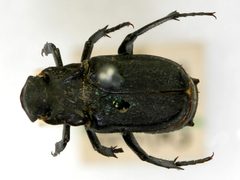
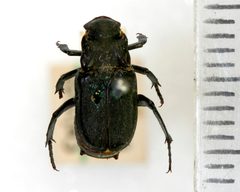
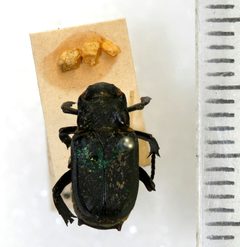
Distinguished from other Cremastocheilus by geographic distribution and association with specific . Most reliably identified by collection from or near Formica ant mounds in its known range. The combination of small size (~10 mm), dull black color, flattened angular body, and heavily textured separates it from other scarab beetles. Within Cremastocheilus, species-level identification requires examination of detailed morphological characters; the is currently undergoing taxonomic revision.
Images
Appearance
are small scarab beetles, approximately 10 mm in length, with a dull black coloration. The body is flattened and angular, with an exceedingly dense bearing pits or wrinkles. The are protected in grooves under the when at rest. The on the underside of the head is enlarged and shield-like, covering other mouthparts from below. The are modified into sharp, piercing appendages. The are reduced and function primarily to transport liquid food. Trichomes—brushes of glandular hairs—are present on the hind angle of the pronotum where it meets the .
Habitat
Found in areas supporting mound-building ants, particularly "goat prairies" and other grassland remnants with thatching (Formica) colonies. Associated with nest mounds constructed from accumulated vegetation. Beetles are found within ant nests at various depths, from periphery (where are laid) to central chambers (where feed).
Distribution
Western and central North America: recorded from Canadian provinces of Alberta, Manitoba, and Saskatchewan; and U.S. states of California, Colorado, Montana, Nebraska, New Mexico, Wisconsin, and Wyoming.
Seasonality
disperse to find new colonies during spring. are laid in soil around nest periphery in spring. Larvae develop through three instars over approximately four months, pupating in late summer. Adults emerge from pupal in late summer or early fall, move to nest centers to accumulate colony scent, and become active the following spring.
Diet
Predatory: feed on larvae and pupae. Larvae feed on decaying vegetation that ants have composted within nest mounds.
Host Associations
- Formica - Primary ; mound-building thatching ants
- Myrmecocystus - Honeypot ants; for
- Lasius - Cornfield ants; for
- Camponotus - Carpenter ants; for
- Pogonomyrmex - Harvester ants; southwestern for
- Veromessor - Harvester ants; southwestern for
- Aphaenogaster - Spine-waisted ants; southwestern for
Life Cycle
Females lay singly in soil around the periphery of nest mounds. Larvae pass through three instars, feeding on composted vegetation and defending themselves against ants with mandibular strikes and repulsive secretions from mandibular and anal glands. occurs in oval chambers constructed from soil particles. The complete cycle from egg to requires approximately four months. Newly emerged adults migrate to nest centers, acquiring colony scent during winter dormancy. Adults are long-lived, surviving through winter to feed on ant the following spring.
Behavior
employ death-feigning () to gain entry to nests: they remain motionless with legs outstretched in areas trafficked by scouting ants, which carry the apparent carcass into the nest. Once inside, adults are largely ignored by ants. Adults are capable of strong, fast and actively disperse to locate new host colonies during spring. Larvae defend themselves actively when attacked by ants.
Ecological Role
within colonies, regulating ant through . The represents a specialized case of myrmecophily, occupying a as an predator that exploits the resource-rich environment of ant nests. Population densities can reach 20–30 individuals per nest, with some colonies hosting up to 200 beetles.
Human Relevance
No direct economic importance. Occasionally encountered by entomologists and naturalists investigating colonies. The and its relatives are of scientific interest for studying myrmecophilous adaptations and -ant evolutionary relationships.
Similar Taxa
- Other Cremastocheilus speciesApproximately 35 in North America north of Mexico share similar and myrmecophilous habits; species-level identification requires detailed examination and geographic knowledge
- Other Cetoniinae scarabsDistinguished by flattened angular body, dense , and association with nests; most flower chafers lack these specialized traits
More Details
Taxonomic status
The Cremastocheilus is currently undergoing revision; boundaries and relationships remain under investigation.
Trichome function
The glandular trichomes on the pronotum were originally hypothesized to secrete pacifying or attractive compounds for ants, but this function has not been confirmed and their purpose remains unresolved.