
Cremastocheilus crinitus
LeConte, 1874
anteater scarab beetle
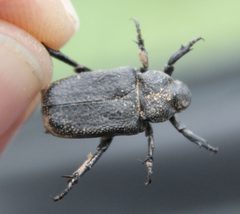
Cremastocheilus crinitus is a myrmecophilous scarab beetle known for its specialized parasitic relationship with ants. enter colonies by feigning death, allowing scavenging to carry them into nests. Once inside, they feed on ant larvae and pupae using modified piercing mouthparts. The is part of a of approximately 35 North American species, commonly called "anteater scarabs" for their predatory toward ant .
Pronunciation
How to pronounce Cremastocheilus crinitus: /krɛˌmæstəˈkaɪləs kraɪˈnaɪtəs/
These audio files are automatically generated. While they are not always 100% accurate, they are a good starting point.
Identification
Members of Cremastocheilus crinitus can be distinguished from other scarab beetles by their flattened, angular body form with dense, heavily sculptured bearing pits and wrinkles. The has reduced and an enlarged, shield-like that covers the other mouthparts from below. The are modified into sharp appendages adapted for piercing larvae. Trichomes—brushes of glandular hairs—are present on the hind angle of the pronotum where it meets the . The are normally concealed in grooves under the when at rest.
Images
Habitat
Distribution
Nearctic region: western and central United States (Arizona, California, Colorado, Idaho, Montana, Nevada, Texas, Utah, Washington) and southwestern Canada (Alberta, British Columbia). Neotropical records from northern Mexico (Baja California, Chihuahua).
Seasonality
disperse to find new colonies during spring and early summer. New adults emerge from pupal in late summer or early fall. Activity within nests occurs year-round, with reduced winter dormancy coordinated with host ant colonies.
Diet
feed on larvae and pupae, piercing soft with modified and consuming liquefied tissues. Larvae feed on decaying vegetation and organic matter composted by ants within nest mounds.
Host Associations
- Formica - primary thatching ants, mound-building
- Myrmecocystus - honeypot ants
- Lasius - cornfield ants
- Camponotus - carpenter ants
- Pogonomyrmex - harvester ants, southwestern US
- Veromessor - harvester ants, southwestern US
- Aphaenogaster - spine-waisted ants, southwestern US
Life Cycle
Females lay singly in soil around nest periphery. Larvae pass through three instars, feeding on decaying vegetation within the nest mound, and defend themselves by striking with and secreting repulsive liquids from mandibular and anal glands. occurs in oval chambers constructed from soil particles. Development from egg to requires approximately four months. Adults emerge in late summer or early fall, move slowly to nest center to acquire colony scent, and overwinter within the ant colony.
Behavior
employ death-feigning () to gain entry to colonies, remaining motionless with legs outstretched in areas trafficked by scouting ants. Once carried into nests, adults are largely ignored by due to chemical camouflage acquired from nest materials. Adults are capable fliers and fast dispersers when seeking new host colonies.
Ecological Role
and of colonies. densities within single nests can reach 200 individuals, though 20-30 is more typical. The relationship is primarily parasitic, with beetles consuming while contributing minimal benefits to the colony.
Human Relevance
No direct economic importance. Occasionally encountered by entomologists and naturalists investigating colonies. Provides a remarkable example of myrmecophily and behavioral in beetles.
Similar Taxa
- Other Cremastocheilus speciesShare myrmecophilous lifestyle, death-feigning , and morphological adaptations; identification to level requires examination of subtle differences in exoskeletal and body proportions
- Other Cetoniinae scarabsNon-myrmecophilous relatives lack the flattened angular body form, concealed , reduced , and pronotal trichomes characteristic of Cremastocheilus