
Cremastocheilus canaliculatus
Kirby, 1827
anteater scarab beetle
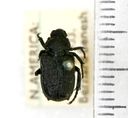
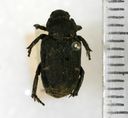
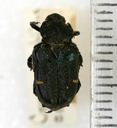
Cremastocheilus canaliculatus is a myrmecophilous scarab beetle in the Cetoniinae. are approximately 10 mm in length, dull black, flattened, and heavily armored with a dense, pitted . The is an obligate associate of colonies, where adults prey on ant larvae and pupae. It occurs in eastern North America, ranging from Ontario and Quebec south through the eastern United States.
Pronunciation
How to pronounce Cremastocheilus canaliculatus: //krɛ.məs.təˈkaɪ.ləs ˌkæn.əˌlɪk.jʊˈleɪ.təs//
These audio files are automatically generated. While they are not always 100% accurate, they are a good starting point.
Identification
Distinguished from other Cremastocheilus by the presence of a distinct longitudinal groove (canaliculatus = "channeled") on the pronotum or . Most similar to other eastern Cremastocheilus species, but specific identification requires examination of pronotal and elytral sculpturing patterns. The combination of small size, flattened form, dull black coloration, and association with mounds separates this from other eastern scarab beetles. may be found in ant nests or crash-landing near foraging trails during .
Images
Habitat
Distribution
Eastern North America: Canada (Ontario, Quebec); United States (Connecticut, Georgia, Indiana, Maryland, Massachusetts, New Hampshire, New Jersey, New York, North Carolina, Pennsylvania, Rhode Island, South Carolina, Tennessee, Virginia, Vermont).
Seasonality
disperse in spring to locate new colonies. New adults emerge from pupal in late summer or early fall, then enter nests to overwinter. Active feeding on ant resumes in spring.
Diet
are specialized of larvae and pupae. Larvae feed on decaying organic matter, likely the composted vegetation accumulated by ants within nest mounds.
Host Associations
- Formica - primary mound-building thatching ants
- Myrmecocystus - honeypot ants
- Lasius - cornfield ants
- Camponotus - carpenter ants
- Pogonomyrmex - harvester ants
- Veromessor - harvester ants
- Aphaenogaster - spine-waisted ants
Life Cycle
Females lay singly in soil around nest periphery. Larvae pass through three instars, feeding on decaying nest material and defended by striking and repulsive secretions. occurs in oval chambers constructed from soil particles. Development from egg to requires approximately four months. Adults accumulate colony scent while moving slowly toward nest center, becoming chemically integrated with ants.
Behavior
employ (death-feigning) to gain entry to nests, remaining motionless with legs outstretched in areas trafficked by foraging . Ants retrieve the seemingly inert beetles as food items. Adults possess modified mouthparts: an enlarged shield-like covers other mouthparts from below, while are adapted into piercing structures for penetrating ant larvae and pupae. are reduced and function only in transporting liquid food.
Ecological Role
within colonies, exerting top-down pressure on . The relationship represents a specialized form of social . Population densities of 20-200 beetles per nest have been recorded, suggesting potentially significant impact on individual host colony dynamics.
Human Relevance
No direct economic importance. Occasionally encountered by entomologists and naturalists excavating nests. The contributes to scientific understanding of myrmecophily and chemical integration between insects.
Similar Taxa
- Other Cremastocheilus speciesMorphologically similar; require examination of pronotal grooves and elytral sculpturing for definitive identification. C. canaliculatus distinguished by the eponymous channel/groove.
- Valgus canaliculatusShares specific epithet and , but belongs to tribe Valgini with -like setae and associations rather than associations. V. canaliculatus males visit flowers; Cremastocheilus do not.
More Details
Mouthpart modifications
The is enlarged and shield-like, covering other mouthparts ventrally. are modified into sharp piercing appendages. These adaptations are specialized for on within the protected nest environment.
Trichome function
Glandular trichomes on the pronotum were historically hypothesized to secrete pacifying or attractive compounds for ants. This interpretation has been challenged, and their precise function remains unresolved.
Chemical camouflage
acquire colony-specific cuticular hydrocarbons through passive exposure while moving through the nest, facilitating social integration with ants.