
Sphaeridium lunatum
Fabricius, 1792
Crescent Water Scavenger Beetle
Sphaeridium lunatum is a small water scavenger beetle in the Hydrophilidae, commonly known as the Crescent Water Scavenger Beetle. The is native to the Palearctic region, with established introduced in North America. It inhabits moist organic substrates, particularly and decaying plant matter. The specific epithet 'lunatum' refers to the crescent-shaped markings on the .
Pronunciation
How to pronounce Sphaeridium lunatum: //sfæˈrɪdi.əm luːˈneɪtəm//
These audio files are automatically generated. While they are not always 100% accurate, they are a good starting point.
Identification
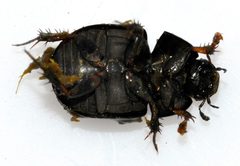
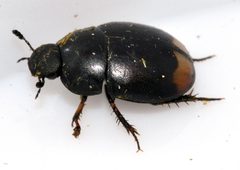
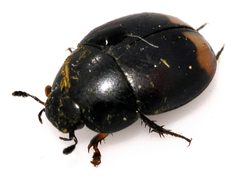
Distinguished from by the crescent-shaped pale markings on the dark . Sphaeridium are separable from other Hydrophilidae by their small size, rounded body form, and association with . Within Sphaeridium, S. lunatum differs from S. scarabaeoides and S. bipustulatum in the specific pattern and shape of elytral markings.
Images
Appearance
Small, oval-bodied with convex surface. display characteristic crescent-shaped (lunulate) markings that give the its name. Typical of Hydrophilidae, the are short with clubbed tips. Body coloration generally dark with contrasting pale markings.
Habitat
Moist organic substrates, particularly herbivore and decaying plant matter. Associated with pastoral and agricultural environments where livestock dung accumulates.
Distribution
Native to Europe and Northern Asia (excluding China): recorded from Belarus, Turkey, Armenia, Israel, Jordan, Kazakhstan, Mongolia, Russia (European Russia, Siberia, Far East, Kuril Islands), Syria, and Tajikistan. Introduced to North America: established throughout Canada (Alberta, British Columbia, Manitoba, New Brunswick, Newfoundland and Labrador, Nova Scotia, Ontario, Quebec, Saskatchewan) and widespread in the United States (at least 36 states including Arizona, California, Connecticut, Illinois, Indiana, Massachusetts, Maine, New Hampshire, Rhode Island, South Carolina, Vermont).
Ecological Role
Contributes to decomposition as part of the . Functions as a decomposer in pastoral .
Human Relevance
Introduced to North America, likely through human-mediated transport associated with livestock or agricultural products. No documented economic impact; part of the naturalized dung beetle fauna in introduced range.
Similar Taxa
- Sphaeridium scarabaeoidesCo-occurs in ; distinguished by different elytral marking pattern (more extensive pale areas rather than distinct crescents)
- Sphaeridium bipustulatumSimilar size and ; separated by elytral pattern of two spots versus crescent shapes
More Details
Introduction History
The North American represents a human-mediated introduction, with the now naturalized across much of the United States and southern Canada. The mechanism and timing of introduction are not documented in available sources.