
Enochrus cinctus
(Say, 1824)
Water Scavenger Beetle
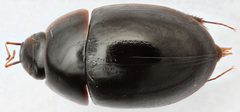
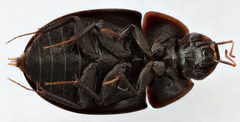
Enochrus cinctus is a of in the Hydrophilidae. It is native to North America, with documented records across much of the United States and southern Canada. As a member of the Hydrophilidae, it is an aquatic associated with freshwater . The species was originally described by Thomas Say in 1824 under the basionym Hydrobius cinctus.
Pronunciation
How to pronounce Enochrus cinctus: /ɪˈnɒkrəs ˈsɪŋktəs/
These audio files are automatically generated. While they are not always 100% accurate, they are a good starting point.
Images
Habitat
Freshwater aquatic environments including ponds, lakes, and slow-moving water bodies.
Distribution
North America: Canada (Manitoba, New Brunswick, Ontario, Quebec, Saskatchewan) and United States (widespread across eastern, central, and southern states including Arkansas, Florida, Georgia, Iowa, Illinois, Indiana, Kansas, Louisiana, Maine, Maryland, Massachusetts, Michigan, Minnesota, Mississippi, Missouri, Nebraska, New Hampshire, New Jersey, New York, North Carolina, North Dakota, Ohio, Pennsylvania, South Carolina, South Dakota, Tennessee, Texas, Virginia, Vermont, West Virginia, Wisconsin).
More Details
Sources and further reading
- BugGuide
- Wikipedia
- GBIF taxonomy match
- iNaturalist taxon
- NCBI Taxonomy
- A Good Morning for a Bee | Bug Squad
- Rosie defoliators: Roseslug sawfly, Endelomyia aethiops, Curled rose sawfly, Allantus cinctus, and Bristley rose sawfly, Cladius pectinicornis — Bug of the Week
- Rosie defoliators - Roseslug sawfly, Endelomyia aethiops, Curled rose sawfly, Allantus cinctus, and Cladius pectinicornis — Bug of the Week
- Sawflies - Curled rose sawfly, Allantus cinctus, and dusky birch sawfly, Croesus latitarsus — Bug of the Week
- Archive — Bug of the Week