
Enochrus
Thomson, C. G., 1859
Species Guides
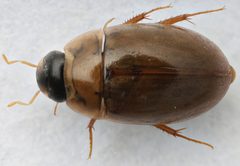
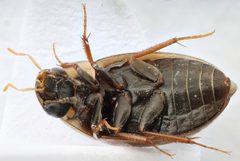
12Enochrus is a of water scavenger beetles (Hydrophilidae) comprising approximately 229 distributed across six subgenera worldwide. It represents the third-largest genus within the Hydrophilidae. Species occur in aquatic and semi-aquatic ranging from permanent ponds to brackish coastal pools. The genus has been documented across multiple continents including South America, North America, Europe, Asia, and the Caribbean.
Pronunciation
How to pronounce Enochrus: //ɛˈnɒkrəs//
These audio files are automatically generated. While they are not always 100% accurate, they are a good starting point.
Identification
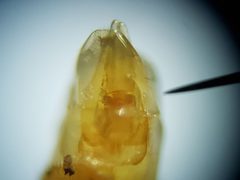
Identification to level in Enochrus requires examination of male genitalia, particularly the and aedeagophore structure. External including elytral punctation patterns, coloration, and general body form provides supporting diagnostic characters. The is divided into six subgenera (Enochrus, Hocophilydrus, Hugoscottia, Hydatotrephis, Lumetus, and Methydrus) based on morphological features. Subgenus-level identification may be possible through structural characters, though specific diagnostic features vary by subgenus.
Images
Habitat
Enochrus occupy diverse aquatic including permanent freshwater ponds, temporary ponds, and brackish coastal pools. Specific documented habitats include: non-eutrophic temporal ponds with muddy bottoms and permanent sun exposure; permanent ponds with macrophyte vegetation; and coastal brackish pools subject to irregular marine inundation with salinity ranging from 4.7 to 62.6 ppt. Vegetation structure, both emergent and submergent, influences microhabitat use and abundance patterns.
Distribution
Worldwide distribution with records from: South America (type locality region, with subgenus Hugoscottia previously restricted to this continent); North America (Mexico, Rica—first records of Hugoscottia outside South America); Europe (including Denmark, Norway); Asia (China, Turkey, with multiple provinces including Yunnan, Xizang, Guizhou, Guangxi); and the Caribbean (Cuba). GBIF records additionally indicate presence in Colombia across multiple departments.
Seasonality
activity patterns vary by and latitude. Enochrus bicolor in coastal England shows greatest adult abundances in August and September, correlating with maximum water temperatures in late summer to early autumn. In tropical Argentina, Enochrus vulgaris was collected year-round with sampling across all months. Presence in most months has been documented for some temperate species.
Behavior
Microhabitat preference varies among and is influenced by vegetation structure. Spatial distribution patterns are related to homogeneity or heterogeneity, with species showing individual differences in use. Macrophytes play a role in by modifying habitat structure and influencing abundance. Specific behavioral observations are limited to individual species studies.
Human Relevance
Several Enochrus are considered of conservation interest in Europe, particularly those associated with brackish water subject to irregular marine inundation. Enochrus bicolor is among species of conservation concern in coastal England. The serves as an indicator group for aquatic habitat quality and salinity variation in wetland .
Similar Taxa
- DerallusBoth are aquatic hydrophilids found in similar permanent pond ; Enochrus differs in genus-level morphological characters and specific microhabitat preferences as demonstrated by co-occurrence studies in Argentina.
More Details
Subgeneric Classification
The comprises six recognized subgenera: Enochrus (sensu stricto), Hocophilydrus, Hugoscottia, Hydatotrephis, Lumetus, and Methydrus. Hydatotrephis was downgraded from generic status in 1990. Hugoscottia was historically restricted to South America but has been documented in Central America and Mexico since 2005.
Taxonomic Research Activity
The remains taxonomically active with new descriptions continuing, including four species from southern China described in 2021 and two from Central America described in 2005. Turkey's fauna was reviewed in 2009 with 12 species recorded and two new country records established.
Sources and further reading
- BugGuide
- Wikipedia
- GBIF taxonomy match
- iNaturalist taxon
- NCBI Taxonomy
- Catalogue of Life
- Hydatotrephis Macleay, a subgenus of Enochrus Thomson (Coleoptera: Hydrophilidae)
- Four new species of Enochrus Thomson (Coleoptera: Hydrophilidae) from southern China
- The genus enochrus thomson (Coleoptera: Hydrophilidae) from Turkey, checklist and new records
- Table 1: Habitat parameters of Enochrus species, together with collection sites.
- Two new species of Enochrus Thomson, subgenus Hugoscottia Knisch, from Costa Rica and Mexico (Coleoptera: Hydrophilidae)
- Effects of seasonal variation in salinity on a population ofEnochrus bicolor Fabricius 1792 (Coleoptera: Hydrophilidae)and implications for other beetles of conservation interest
- First Record of Enochrus (Lumetus) Hamiltoni From Cuba (Coleoptera: Hydrophilidae) With Notes On Its Habitat
- Population parameters of two water scavenger beetles: <i>Derallus angustus</i> Sharp, 1882 and <i>Enochrus vulgaris</i> (Steinheil, 1869) (Coleoptera: Hydrophilidae) in permanent ponds: spatial distribution and microhabitat preference
- Population parameters of two water scavenger beetles:Derallus angustusSharp, 1882 andEnochrus vulgaris(Steinheil, 1869) (Coleoptera: Hydrophilidae) in permanent ponds: spatial distribution and microhabitat preference