
Cryptopleurum minutum
(Fabricius, 1775)
Cryptopleurum minutum is a minute water scavenger beetle in the Hydrophilidae, Sphaeridiinae. First described by Fabricius in 1775, this is native to the Palearctic region but has been introduced to North America. The species is associated with wet, decaying organic matter and typical of sphaeridiine hydrophilids.
Pronunciation
How to pronounce Cryptopleurum minutum: /ˌkrɪptoʊˈplʊərəm mɪˈnjuːtəm/
These audio files are automatically generated. While they are not always 100% accurate, they are a good starting point.
Identification
Distinguished from other North American Cryptopleurum by its minute size and association with decaying organic substrates rather than aquatic environments. The Cryptopleurum can be separated from other sphaeridiine genera by the combination of: body broadly oval and strongly convex; maxillary palpi not enlarged; prosternal process narrow, not expanded posteriorly; and mesoventrite with distinct elevation. Within the genus, C. minutum is among the smallest and lacks the pronounced surface sculpturing seen in some .
Images
Appearance
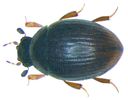
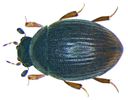
Very small , body length approximately 1.5–2.5 mm. Body compact, broadly oval to subcircular in view, strongly convex. Coloration dark brown to black, often with faint metallic luster. short with distinct 3-segmented club. completely covering , with fine punctation and short . Hind legs not modified for swimming (distinctive of Sphaeridiinae). Tarsal formula 5-5-5. Distinguished from similar Cryptopleurum by small size and subtle differences in pronotal and elytral proportions.
Habitat
Found in moist to wet decaying organic matter, including , compost, decaying fungi, and wet leaf litter. Unlike many Hydrophilidae, not truly aquatic; occupies saturated terrestrial microhabitats. Associated with animal dung in pastures and woodland settings.
Distribution
Native to Europe and Northern Asia (excluding China): recorded from Armenia, Kazakhstan, Kyrgyzstan, and Russia (Far East). Introduced to North America: established in Canada (Alberta, British Columbia, Manitoba, New Brunswick, Newfoundland and Labrador, Nova Scotia, Ontario, Quebec) and widespread in the United States (California, Colorado, Connecticut, Florida, Idaho, Illinois, Indiana, Iowa, Kansas, Maine, Maryland, Massachusetts, Michigan, Minnesota, Montana, Nebraska, New Hampshire, New Jersey, New York, North Carolina, North Dakota, Ohio, Oregon, Pennsylvania, Rhode Island, South Carolina, South Dakota, Utah, Vermont, Virginia, Washington, West Virginia, Wisconsin). Also recorded from China (Gansu, Inner Mongolia, Qinghai).
Diet
Presumed feeding on decaying organic matter, microorganisms, and possibly fungal in substrate; specific feeding habits not documented.
Life Cycle
Complete with , larval, pupal, and stages. Larvae likely develop within moist organic substrate. Specific developmental details unrecorded; probably multivoltine in favorable conditions.
Behavior
Ecological Role
Contributes to decomposition and nutrient cycling in wet organic matter . Member of the of small that process and decaying plant material.
Human Relevance
No direct economic significance; occasionally encountered in compost and agricultural settings. Non-pest .
Similar Taxa
- Cryptopleurum subtileOverlapping distribution and similar size; distinguished by more elongate body and finer surface sculpturing
- Cercyon spp.Similar size and preference in ; distinguished by different body shape (more elongate) and prosternal structure
- Sphaeridium spp.Similar in and decaying matter; distinguished by larger size and more convex, hemispherical body form
More Details
Taxonomic history
Originally described by Fabricius in 1775, making it one of the earlier described in the Hydrophilidae. The Cryptopleurum was long confused with related genera until modern revisions clarified boundaries based on male genitalia and other structural characters.
Introduction to North America
The is considered introduced (non-native) in North America, likely arriving via human-mediated transport of livestock, manure, or organic materials. First North American records date to the early 20th century; now widespread across temperate regions of Canada and the United States.