
Calopteron reticulatum
(Fabricius, 1775)
Reticulated Net-winged Beetle, Banded Net-winged Beetle
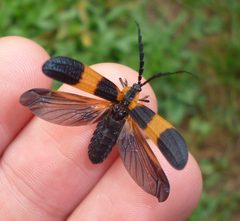
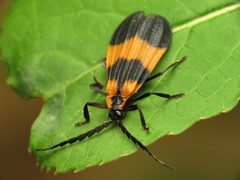
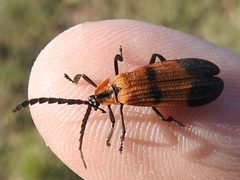
Calopteron reticulatum is a of net-winged beetle in the Lycidae, commonly known as the reticulated net-winged beetle or banded net-winged beetle. It is found in North America, where are active during the day. The species develops in dead or decaying wood, with larvae hunting in leaf litter and feeding on small arthropods. Its black and orange banded coloration is part of a Müllerian mimicry complex involving other chemically defended beetles.
Pronunciation
How to pronounce Calopteron reticulatum: //kæˈlɒptərɒn ˌrɛtɪˈkjʊleɪtəm//
These audio files are automatically generated. While they are not always 100% accurate, they are a good starting point.
Identification
Distinguished from the closely related Calopteron discrepans (which shares the 'banded net-winged beetle') by specific pattern details. The reticulated surface texture of the separates it from smooth-winged mimics such as soldier beetles (Cantharidae) and some longhorn beetles (Cerambycidae). The soft, flexible elytra distinguish Lycidae from most other .
Images
Appearance
Habitat
are found in areas with dead or decaying trees, which serve as oviposition sites and sites. Larvae occur in leaf litter. The is associated with forested and woodland environments where suitable decaying wood and leaf litter are present.
Distribution
North America, including Canada (Ontario, Québec), the United States, and Mexico.
Seasonality
are active during the day; in temperate regions, activity likely peaks in late summer and autumn based on related ' .
Diet
feed on nectar and honeydew secreted by aphids and related insects. Larvae are predatory, hunting and consuming other small arthropods in leaf litter.
Life Cycle
are laid on dead or decaying trees. Larvae develop in leaf litter, feeding on small arthropods. occurs in dead trees. The exhibits complete with distinct egg, larval, pupal, and stages.
Behavior
are . Net-winged beetles may raise and lower their in a display , though this has been specifically documented in related . The species participates in a Müllerian mimicry complex with other aposematically colored beetles.
Ecological Role
Larvae function as in leaf litter . may contribute to nutrient cycling through their feeding on honeydew and nectar. The serves as a model in Müllerian mimicry complexes, reinforcing predator learning about aposematic coloration shared with other chemically defended insects.
Human Relevance
Not a significant pest. Like other Lycidae, are visually conspicuous and may be encountered by naturalists and entomologists. The has no known economic importance.
Similar Taxa
- Calopteron discrepansShares the 'banded net-winged beetle' and has similar black and orange banding; requires careful examination to distinguish
- Calopteron terminaleAnother North American Calopteron with similar color pattern and reticulated ; occurs in same mimicry complex
- Chauliognathus basalis (Colorado Soldier Beetle)Mimics Calopteron in color pattern but has smooth, hardened and different body proportions
- Chauliognathus deceptusSimilar mimicry relationship as C. basalis, with overlapping geographic range in some areas
- Crossidius discoideusBatesian mimic of the soldier beetle/lycid color pattern; distinguished by long and different body form
More Details
Mimicry complex
Calopteron reticulatum participates in a Müllerian mimicry complex involving other Lycidae, soldier beetles (Cantharidae), and blister beetles (Meloidae). All participants share black and orange/yellow aposematic coloration and possess chemical defenses. This shared warning signal reinforces avoidance learning.
Nomenclatural note
The 'banded net-winged beetle' is also applied to Calopteron discrepans, which can cause confusion. 'Reticulated net-winged beetle' is the preferred common name for C. reticulatum to minimize ambiguity.