
Lycinae
Laporte, 1838
net-winged beetles
Tribe Guides
2- Calopterini
- Lycini(Typical Netwing Beetles)
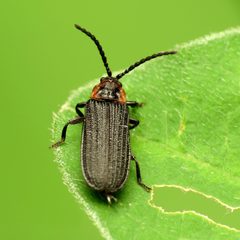
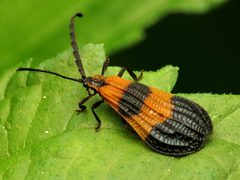
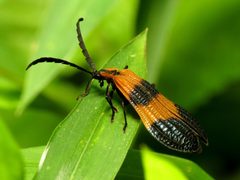
Lycinae is a of net-winged beetles ( Lycidae) containing approximately 11 tribes and numerous distributed across tropical and subtropical regions. Members are characterized by their soft, flexible with prominent net-like venation. The subfamily includes familiar genera such as Lycus, Calopteron, and Macrolycus. Many exhibit aposematic (warning) coloration, often in orange, red, or black patterns.
Pronunciation
How to pronounce Lycinae: //lɪˈsaɪniː//
These audio files are automatically generated. While they are not always 100% accurate, they are a good starting point.
Identification
Distinguished from other Lycidae by combination of: soft with regular reticulate venation (not irregularly punctate), serrate to pectinate , and pronotal structure. Separated from unrelated beetles with similar coloration (e.g., Cerambycidae, Oedemeridae) by the unique net-veined elytra texture and antennae structure. Male genitalia and specific venation patterns often required for -level identification.
Images
Habitat
Primarily tropical and subtropical forests. frequent vegetation along forest edges, stream corridors, and areas with abundant flowering plants. Larval include decaying wood, leaf litter, and soil organic matter; specific microhabitat associations vary by .
Distribution
Pantropical with extensions into warm temperate zones. Greatest diversity in Southeast Asia, tropical Africa, and the Neotropics. Some (e.g., Calopteron, Lycus) occur in eastern North America and eastern Asia.
Seasonality
activity peaks during warm, humid periods coinciding with flowering seasons. In temperate regions, adults active late spring through summer. Tropical may show year-round activity with peaks during rainy seasons.
Life Cycle
Complete with poorly documented larval stages. Larvae are believed to be predatory or detritivorous in decaying wood and soil. occurs in soil or within larval galleries. lifespan appears relatively short, focused on .
Behavior
are slow, clumsy fliers often observed resting on vegetation. Many aggregate in mating swarms. When disturbed, adults may reflex-bleed from leg joints, releasing defensive compounds. Some exhibit activity with peaks.
Ecological Role
likely contribute to pollination through visitation of diverse flowers. Larval stages participate in nutrient cycling through wood decomposition. Aposematic coloration indicates chemical defense production, contributing to education in forest .
Human Relevance
Minimal direct economic impact. Occasionally encountered by entomologists and naturalists. Some brightly colored (e.g., Lycus loripes group) are familiar in North American field guides. No significant agricultural or medical importance documented.
Similar Taxa
- CalochrominaeSometimes treated as rather than tribe within Lycinae; distinguished by more robust body form and modified male
- ErotinaeOther Lycidae with softer, less regularly reticulate and different pronotal structure
- DictyopteraUnrelated order with similar name; distinguished by leathery forewings, chewing mouthparts, and hemimetabolous development
More Details
Taxonomic complexity
Tribal classification within Lycinae remains fluid, with 11 tribes recognized by some authorities (Calochromini, Calopterini, Conderini, Dihammatini, Eurrhacini, Lycini, Lyponiini, Macrolycini, Melanerotini, Metriorrhynchini, Platerodini, Thonalmini). Generic boundaries and tribal placements continue to be revised based on molecular and morphological studies.
Chemical defense
Like other Lycidae, Lycinae synthesize pyrazine-based defensive compounds and lycidic acid derivatives. These chemicals are sequestered from larval diet or de novo synthesized, making unpalatable to vertebrate and . This chemical protection facilitates Müllerian mimicry complexes with unrelated beetles, , and other insects.