
Lycini
Laporte, 1838
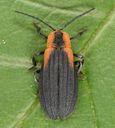
Typical Netwing Beetles
Genus Guides
4- Lyconotus
- Lycostomus
- Lycus(Netwing Beetles)
- Neolycus
Lycini is a -rich tribe of netwing beetles within the Lycidae, distinguished by a suite of morphological characters including a rostrum and specialized , genitalia, and respiratory structures. Members occur across six biogeographic regions but are absent from the southern Neotropics and most of the Australian region. The tribe contains seven as delimited by 2021 molecular phylogenetic study.


Pronunciation
How to pronounce Lycini: //ˈlaɪ.sɪˌnaɪ//
These audio files are automatically generated. While they are not always 100% accurate, they are a good starting point.
Identification
distinguished from other lycid tribes by combination of: rostrum present; antennomeres 3–10 flat, serrate to parallel-sided; pronotal carinae absent; with weak longitudinal and absent or irregular transverse costae; mesothoracic tubular. Male genitalia with spoon-shaped phallobase, short parameres, and long slender phallus. Female reproductive tract with large lateral glands in sexual duct, short valvifers, and short spermaduct.
Images
Distribution
Afrotropical, Palaearctic, Oriental, Nearctic, and northern Neotropical regions; Australian region restricted to Sulawesi and Timor only.
More Details
Included genera
Seven : Celiasis (Laporte, 1840), Haplolycus (Bourgeois, 1883), Lipernes (Waterhouse, 1879), Lycostomus (Motschulsky, 1861), Lycus (Fabricius, 1787), Neolycus (Bourgeois, 1883), and Rhyncheros (LeConte, 1881). Generic boundaries established by 2021 mito-ribosomal phylogenetic analysis.
Taxonomic authority
Authorship attributed to Laporte, 1838 (Catalogue of Life) or Laporte, 1840 (Wikipedia source referencing Celiasis description date). The tribe description predates the 2021 molecular revision that stabilized current generic circumscription.