
Xyloterinus politus
(Say, 1826)
Polished Bark Beetle
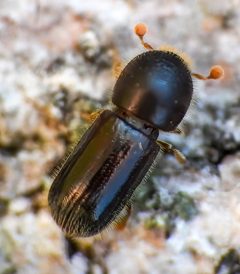
Xyloterinus politus is a North American ambrosia beetle in the Curculionidae, historically placed in . It is the sole in the Xyloterinus. The species exhibits obligate mutualism with cultivated fungi, excavating galleries in hardwood and softwood trees where it grows and feeds on ambrosial fungi rather than wood tissue. Females initiate gallery construction and maintain fungal gardens; males do not excavate galleries and are excluded from active attacks. The overwinters as an in old galleries and cradles.
Pronunciation
How to pronounce Xyloterinus politus: /zɪloʊtəˈraɪnəs pəˈlaɪtəs/
These audio files are automatically generated. While they are not always 100% accurate, they are a good starting point.
Images
Habitat
Wood galleries within living or dead trees; specifically excavates tunnels in sapwood and xylem of trees. Creates simple gallery systems with entrance holes penetrating sapwood before branching into secondary tunnels at right angles. Galleries contain cradles—cup-shaped chambers where are laid and larvae develop, lined with cultivated ambrosial fungi.
Distribution
Native to North America. GBIF records indicate presence in North America with specific records from Belgium (presence/absence data likely representing introduced or intercepted specimens).
Diet
Xylomycetophagous; feeds exclusively on cultivated ambrosial fungi growing on gallery walls. and larvae consume fungal mycelia. The does not feed on wood tissue itself but rather on the fungi it cultivates within wood galleries.
Host Associations
- Ambrosiella - primary fungal main cultivated ambrosia fungus
- Candida xyloterini - yeast associatenovel yeast described from body surface and galleries
- Candida palmyrensis - yeast associatenovel yeast described from body surface and galleries
- Saccharomycopsis microspora - yeast associateisolated from body surface and galleries
- Wickerhamomyces hampshirensis - yeast associateisolated from body surface and galleries
- Candida mycetangii - yeast associateisolated from body surface and galleries
- Fusarium - fungal associateisolated from galleries
- Penicillium - fungal associateisolated from galleries
- Aspergillus - fungal associateisolated from galleries
- Ipideurytoma sp. - probable larval (Hymenoptera: Eurytomidae) found in cradles
- black oak (Quercus velutina) - treeexplicitly mentioned as attacked in yeast study
Life Cycle
laid singly in cup-shaped cradle excavated by female; cradle opening plugged with throughout stages. Three larval instars based on capsule measurements; larvae lengthen their cradles during development. Positive correlation exists between larval head width and cradle length. occurs within the cradle. emerges by forcing frass plug, then re-enters cradle in reversed position to feed on ambrosial fungus. Overwinters as adult in old cradles and galleries.
Behavior
Females initiate and excavate galleries alone; single female per active gallery. Males never initiate or excavate galleries and are forcibly excluded from entrance holes by females when placed in active attacks. transport fungal spores in specialized body structures (mycangia). adults exhibit unique feeding : after , they re-enter their cradles in reversed position to feed on ambrosial fungus growing on cradle walls. Larvae actively lengthen their cradles as they grow.
Ecological Role
Ambrosia beetle contributing to wood decomposition through fungal rather than direct wood-feeding. ambrosial fungi into sapwood, establishing mutualistic fungal gardens that serve as food source. Contributes to nutrient cycling in forest via -fungus . Creates structure (galleries and cradles) that may be used by other organisms.
Human Relevance
Infests both hardwood and softwood trees as well as stacks of logs, potentially impacting timber and forestry operations. The and its fungal associates may affect wood quality in commercial logging.
More Details
Sex ratio and gallery system
Sex ratio is biased toward females with a factor of 0.84. The gallery system is structurally simple: entrance hole penetrates into sapwood for a variable distance before branching into secondary tunnels at right angles to the main gallery.
Taxonomic history
Historically classified in , now treated as Scolytinae within Curculionidae. Basionym Apate politus reflects older .
Fungal specificity
While Ambrosiella is the primary cultivated fungus, the associates with a diverse yeast including two novel (Candida xyloterini and Candida palmyrensis) described specifically from this beetle.
Sources and further reading
- BugGuide
- GBIF taxonomy match
- iNaturalist taxon
- NCBI Taxonomy
- Catalogue of Life
- Meloidae Holdings | Entomology Research Museum
- Bug Eric: More Beetles from Bones
- ID Challenge #19 | Beetles In The Bush
- Orthoptera | Beetles In The Bush | Page 4
- Bug Eric: June 2011
- Fungi associated with Xyloterinus politus (Say) (Coleoptera: Scolytidae)
- THE LIFE HISTORY OF THE AMBROSIA BEETLE XYLOTERINUS POLITUS (COLEOPTERA: SCOLYTIDAE)
- Symbiontic interrelationships between microbes and ambrosia beetles IV. Ambrosial fungi associated with Xyloterinus politus
- Yeasts associated with the curculionid beetle Xyloterinus politus: Candida xyloterini sp. nov., Candida palmyrensis sp. nov. and three common ambrosia yeasts