
Xyloterinus
Swaine, 1918
Species Guides
1- Xyloterinus politus(Polished Bark Beetle)
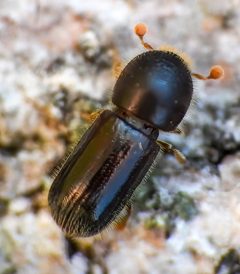
Xyloterinus is a of ambrosia beetles in the Curculionidae, containing the single Xyloterinus politus. Native to eastern North America, this infests both hardwood and softwood trees, particularly recently fallen or cut timber. The species cultivates fungal gardens in wood galleries and has been extensively studied for its symbiotic relationships with yeasts and other fungi.
Pronunciation
How to pronounce Xyloterinus: //zaɪloʊtəˈraɪnəs//
These audio files are automatically generated. While they are not always 100% accurate, they are a good starting point.
Identification
As a , Xyloterinus contains only Xyloterinus politus. The can be distinguished from other ambrosia beetles by its small size (2.3–3.5 mm), dark brown to blackish body with brown covered in yellowish bristle-like setae, and a squarish prothorax bearing spines and two to four teeth. Gallery entrance holes are approximately 1.6 mm in diameter.
Images
Habitat
Found in the wood of recently fallen, cut, or dying trees. Infests both hardwoods and softwoods including Acer, Alnus, Betula, Carya, Castanea, Fagus, Fraxinus, Picea, Pinus, Quercus, Tsuga, and Ulmus. Also occurs in stacked logs.
Distribution
Native to eastern North America, present in both Canada and the United States. GBIF records document occurrence in Vermont, USA.
Host Associations
- Ipideurytoma sp. - Larval ; larvae found in cradles
Ecological Role
Ambrosia beetle that cultivates fungal gardens in wood galleries, participating in a mutualistic relationship with fungal . Associated with multiple yeast including Candida xyloterini, Candida palmyrensis, Saccharomycopsis microspora, Wickerhamomyces hampshirensis, and Candida mycetangii. Contributes to wood decomposition through fungal .
Human Relevance
Considered a pest of timber and stored logs. Attacks both hardwood and softwood of economic importance.
More Details
Fungal Symbionts
Xyloterinus politus is associated with a diverse of yeasts. Two novel yeast , Candida xyloterini and Candida palmyrensis, were first described from this . Candida xyloterini is notable for assimilating methanol as a sole carbon source.
Sources and further reading
- BugGuide
- Wikipedia
- GBIF taxonomy match
- iNaturalist taxon
- NCBI Taxonomy
- Catalogue of Life
- Fungi associated with Xyloterinus politus (Say) (Coleoptera: Scolytidae)
- THE LIFE HISTORY OF THE AMBROSIA BEETLE XYLOTERINUS POLITUS (COLEOPTERA: SCOLYTIDAE)
- Symbiontic interrelationships between microbes and ambrosia beetles IV. Ambrosial fungi associated with Xyloterinus politus
- Yeasts associated with the curculionid beetle Xyloterinus politus: Candida xyloterini sp. nov., Candida palmyrensis sp. nov. and three common ambrosia yeasts