
Ambrosiodmus
Hopkins, A.D., 1915
Species Guides
6Ambrosiodmus is a of ambrosia beetles (Scolytinae) in the Curculionidae, comprising at least 100 described . These beetles are distinguished by their obligate mutualism with the white-rot decay fungus Flavodon subulatus (formerly Flavodon ambrosius), a unique among ambrosia beetles. Unlike most ambrosia fungi that merely extract nutrients from recently dead wood, Flavodon is a true wood degrader capable of decomposing cellulose and lignin. This superior fungal mutualist enables Ambrosiodmus species to establish large, semi-social colonies with thousands of individuals and to colonize and decay wood over multiple . Several species, including A. minor and A. rubricollis, have become outside their native ranges.
Pronunciation
How to pronounce Ambrosiodmus: /æmˌbroʊziˈɒdməs/
These audio files are automatically generated. While they are not always 100% accurate, they are a good starting point.
Identification
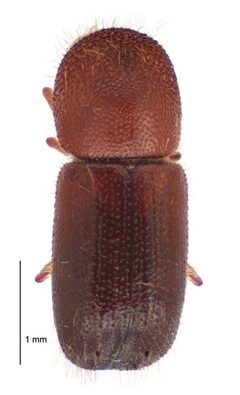
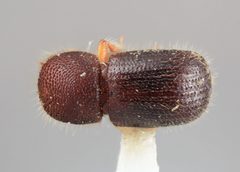
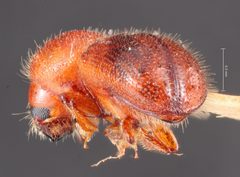
Ambrosiodmus are distinguished from other ambrosia beetles by the presence of asperities (small, rough projections) covering the entire surface of the pronotum. This feature was specifically noted as the most characteristic trait separating A. rubricollis from other ambrosia beetle species in Europe. Members of this can be differentiated from the related genus Ambrosiophilus by morphological characteristics detailed in identification keys, though specific distinguishing traits require expert examination.
Images
Habitat
Dead and decaying wood, particularly in recently dead trees that still contain nutrients. The association with Flavodon subulatus allows of wood in more advanced stages of decay than typical ambrosia beetles. occupy commercial plantations, urban forests, and natural woodlands in introduced ranges.
Distribution
Native to eastern and southern Asia. Introduced established in southeastern United States (including Florida), mainland China (range expanding), Portugal, and Slovenia. The has demonstrated capacity for long-distance and establishment in non-native globally.
Diet
and larvae feed on fungal gardens of Flavodon subulatus cultivated within galleries. The fungus converts decayed wood into complete animal nutrition, providing a diet unavailable to most other ambrosia beetles.
Host Associations
- Flavodon subulatus - obligate mutualistPrimary fungal ; white-rot decay fungus that digests wood and provides nutrition to beetles. Previously referred to as Flavodon ambrosius.
- Eucalyptus globulus - plantTasmanian blue gum; documented for A. rubricollis in Portugal, representing first record of this on eucalypts worldwide.
- Various woody plants - plant; multiple documented on diverse tree and shrub species in introduced ranges.
Behavior
Cultivates fungal gardens of Flavodon subulatus in galleries excavated in wood. inoculate new tunnels with fungal spores carried in specialized mycangia (fungus pockets). The superior wood-degrading capacity of Flavodon enables colonies to persist for multiple in the same wood substrate, with adults remaining to reproduce rather than dispersing immediately. This facilitates development of complex semi-social colonies containing thousands of individuals, an unusual social structure among ambrosia beetles. Some have been observed to engage in , including tunneling into established galleries to steal fungal gardens and direct attacks on conspecifics to usurp colonies.
Ecological Role
Accelerates wood decomposition through association with Flavodon subulatus, contributing to nutrient cycling in forest . The fungal mutualist causes rapid wood rot, distinguishing this from other ambrosia beetles that do not significantly degrade wood structure. may alter decomposition dynamics in non-native forests and potentially pathogenic fungi to living trees.
Human Relevance
Several are pests of forestry concern. Ambrosiodmus minor is established in the southeastern United States with increasing of wood decay in dead trees, though currently considered of low economic importance. A. rubricollis has been detected in Europe (Portugal, Slovenia) and may pose threat to eucalypt plantations and other woody crops. The association with Flavodon subulatus produces distinctive of rapid wood rot that may affect timber quality and structural integrity of dead trees. Research interest in the enzymatic capabilities of Flavodon for potential biotechnological applications in wood processing.
Similar Taxa
- AmbrosiophilusRelated of ambrosia beetles also associated with Flavodon ambrosius; both genera share the unique wood-degrading fungal mutualism and semi-social colony structure. Distinguished by morphological characteristics in identification keys.
- Other ambrosia beetle genera (e.g., Xyleborus, Xylosandrus)Most ambrosia beetles cultivate fungi that are poor wood degraders and extract only easily available nutrients from recently dead wood. Ambrosiodmus is distinguished by its association with the aggressive white-rot fungus Flavodon subulatus, enabling true wood decomposition and multi-generational colonies.
More Details
Unique fungal mutualism
Ambrosiodmus represents the only known ambrosia beetle to have evolved a mutualism with a true wood-degrading fungus. The Flavodon subulatus is metabolically distinct from all other ambrosia fungi, having evolved from free-living bracket fungi (Polyporales) rather than from plant-pathogenic lineages. This evolutionary transition involved dramatic genetic and ecological changes, including loss of and independent existence. The fungus is the closest known relative of the bracket fungus genus Flavodon, not previously known to participate in insect .
Research significance
The Ambrosiodmus-Flavodon serves as a model system for studying wood borer-fungus relationships, with methodological approaches combining quantitative culturing, whole- amplification, high-throughput sequencing, and histological sectioning of mycangia. The enzymatic apparatus of Flavodon subulatus is of biotechnological interest for potential applications in converting wood to food or other products.
Sources and further reading
- BugGuide
- Wikipedia
- GBIF taxonomy match
- iNaturalist taxon
- NCBI Taxonomy
- Catalogue of Life
- Ambrosiodmus-lecontei - Entomology Today
- Ambrosiodmus Archives - Entomology Today
- Research on Fungus-farming Beetles Reveals a New Wood-decaying Fungus
- Beetle Farmers 2.0: A Super-symbiont Fungus Supports a Complex Beetle Society
- Ambrosiodmus rubricollis (Eichhoff) (Coleoptera; Curculionidae; Scolytinae) associated with young Tasmanian blue gum trees
- New Area Records and New Hosts of Ambrosiodmus minor (Stebbing) (Coleoptera: Curculionidae: Scolytinae) in Mainland China
- The Punky Wood Ambrosia Beetle and Fungus in Florida that Cause Wood Rot: Ambrosiodmus minor and Flavodon subulatus
- First Record of the Introduced Ambrosia Beetle Ambrosiophilusnodulosus (Eggers) in Mississippi, with Notes on the Distribution of Ambrosiodmus minor (Stebbing) (Coleoptera: Curculionidae: Scolytinae)
- The first record of two non-native ambrosia beetles in Slovenia: Ambrosiodmus rubricollis (Eichhoff, 1875) and Ambrosiophilus atratus (Eichhoff, 1875) (Coleoptera: Curculionidae, Scolytinae)