
Phloeotribus
Latreille, 1797
Species Guides
7- Phloeotribus dentifrons
- Phloeotribus frontalis(crenulate bark beetle)
- Phloeotribus lecontei(LeConte's Bark Weevil)
- Phloeotribus liminaris(Peach Bark Beetle)
- Phloeotribus piceae
- Phloeotribus pseudoscabricollis(crenulate bark beetle)
- Phloeotribus texanus
Phloeotribus is a of crenulate bark beetles in the Curculionidae, comprising at least 150 described . Species within this genus exhibit diverse associations, with some specializing on olive (Olea europaea), others on stone fruits (Prunus spp.), and some on broom (Cytisus scoparius). The genus includes economically significant pests such as Phloeotribus scarabaeoides, which damages olive trees through feeding and breeding gallery construction. vary among species, with both monogynous and bigynous mating systems documented.
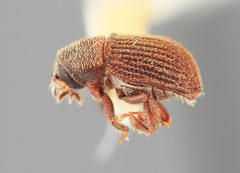
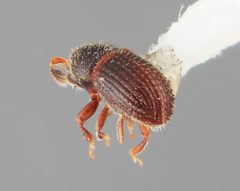
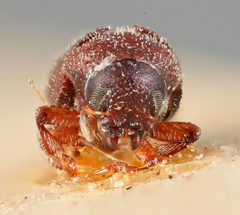
Pronunciation
How to pronounce Phloeotribus: //flɛˈoʊ.trɪ.bəs//
These audio files are automatically generated. While they are not always 100% accurate, they are a good starting point.
Identification
Members of Phloeotribus can be recognized as crenulate bark beetles within Curculionidae. Specific identification to requires examination of morphological characters not detailed in available sources. The is distinguished from related scolytine genera by features associated with the crenulate (scalloped or notched) body surface, though precise diagnostic characters are not provided in the source material.
Images
Habitat
occupy diverse corresponding to their plants. Phloeotribus scarabaeoides occurs in olive groves and orchards. Phloeotribus rhododactylus inhabits areas supporting Cytisus scoparius, primarily in Mediterranean and coastal climates. Phloeotribus liminaris and P. pruni are associated with Prunus species in temperate regions. Species typically colonize stressed, damaged, or recently cut host material.
Distribution
The has a broad distribution with -specific ranges. Phloeotribus rhododactylus ranges from Spain and southern Sweden/Denmark/Scotland east to Poland, Slovakia, and Hungary, with scattered records in Romania, Bulgaria, and Greece. Distribution records from GBIF include Denmark, Norway, Sweden, and Vermont (USA). Specific distributions for most of the 150+ species are not documented in available sources.
Host Associations
- Olea europaea - Primary for P. scarabaeoides; beetles feed on phloem tissue and construct breeding galleries in bark
- Cytisus scoparius - Main for P. rhododactylus; beetles infest damaged or stressed plants
- Prunus serotina - for P. liminaris
- Prunus persica - Associated with P. pruni and tree collapse in Mexico
Behavior
Males of at least some (e.g., P. demessus) remain with females during gallery construction and -laying. Burrow-blocking has been observed. Species produce chemical attractants including α-pinene, β-pinene, 2-decanone, 2-nonanone, decanal, undecanal, and n-butyl acetate. Attraction to material varies with branch age, with semi-dried (10-day aged) olive branches being most attractive to P. scarabaeoides.
Ecological Role
Several function as pests of cultivated trees, particularly olives and stone fruits. Phloeotribus scarabaeoides acts as a for fungal in olive trees. The serves as for including Cheiropachus quadrum (Pteromalidae) and Dendrosoter protuberans (Braconidae). are influenced by both and , with -dependent regulation occurring primarily through female attack .
Human Relevance
Phloeotribus scarabaeoides is a significant pest of olive in the Mediterranean region, causing damage through feeding gallery construction in living trees and in pruned logs. Management strategies include applications (deltamethrin, organophosphorus compounds) and attractant-based lure-and-trap systems using ethylene or acetone extracts. The Cheiropachus quadrum has been investigated for but provides only limited suppression (approximately 20%) due to mutual interference effects.
Similar Taxa
- ScolytusBoth are scolytine bark beetles with similar gallery construction ; Phloeotribus is distinguished by crenulate body surface and different associations
- ThysanoesShares bigynous mating system in some ; differs in specific relationships and morphological details
- HylocurusAssociated scolytid found in similar but with distinct preferences and morphological characteristics
Sources and further reading
- BugGuide
- Wikipedia
- GBIF taxonomy match
- iNaturalist taxon
- NCBI Taxonomy
- Catalogue of Life
- Optimization of bioassay conditions for the olive bark beetle Phloeotribus scarabaeoides
- The Bark Beetle Phloeotribus rhododactylus (Coleoptera: Curculionidae) Has a Stable Range in Europe
- Response of Parasitoids Dendrosoter protuberans and Cheiropachus quadrum to Attractants of Phloeotribus scarabaeoides in an Olfactometer
- Effect of Olive Branch Aging and Extracts on the Attraction of Olive Neiroun Beetles Phloeotribus Scarabeioides (Bern)
- Chemically-mediated host colonization of black cherry trees,Prunus serotina, by the peach bark beetle,Phloeotribus liminaris(Coleoptera: Scolytinae)
- Effect of parent density on fecundity of two parasitoids [Hym.: Pteromalidae] of the olive beetle,Phloeotribus scarabaeoides [Col.: Scolytidae]
- Deltamethrin application on colonized olive logs: Effect on the emergence of the olive bark beetle Phloeotribus scarabaeoides Bernard 1788 (Coleoptera: Scolytidae) and its associated parasitoids
- The population dynamics of the bark beetle Phloeotribus scarabaeoides (Col., Scolytidae) on European olive (Olea europaea)
- The role of parasitism in the population dynamics of the bark beetle Phloeotribus scarabaeoides (Col., Scolytidae) on European olives (Olea europaea)
- Notes on the breeding biology of some bigynous and monogynous Mexican bark beetles (Scolytidae: Scolytus, Thysanoes, Phloeotribus) and records for associated Scolytidae (Hylocurus, Hypothenemus, Araptus) and Platypodidae (Platypus)
- Effect of the combined treatment of insecticides and an attractant for the control of Phloeotribus scarabaeoides , a pest of Olea europea
- Effects of parasitoid spatial heterogeneity, sex ratio and mutual interference on the interaction between the olive bark beetle Phloeotribus scarahaeoides (Col., Scolytidae) and the pteromalid parasitoid Cheiropachus quadrum (Hym., Pteromalidae)
- Phloeotribus pruni(Coleoptera: Scolytidae) Associated with Peach (Prunus persica) Collapse in Coatepec de Harinas, State of Mexico, Mexico