
Cheiropachus
Westwood, 1829
Cheiropachus is a of in the Pteromalidae, first described by Westwood in 1829. within this genus are known to parasitize bark beetles (), with C. quadrum being the most studied species due to its role as a agent of olive bark beetles in southern Europe. The genus occurs in Europe and North America, with at least ten recognized species.
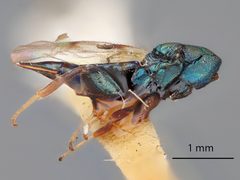
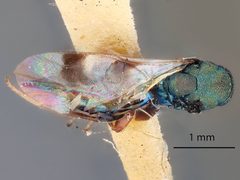

Pronunciation
How to pronounce Cheiropachus: //ˌkaɪ.roʊˈpæk.əs//
These audio files are automatically generated. While they are not always 100% accurate, they are a good starting point.
Images
Habitat
Associated with bark beetle , particularly in woody trees where bark beetles breed. C. quadrum has been documented in olive-growing regions of southern Spain, where it parasitizes olive bark beetles (Hylesinus varius and Phloeotribus scarabaeoides) within their breeding galleries in olive wood.
Distribution
Europe and North America. Specific distribution records include Denmark, Norway, and Sweden (GBIF). C. quadrum has been documented in southern Spain.
Host Associations
- Hylesinus varius - Olive bark beetle; C. quadrum parasitizes pupae and all larval instars
- Phloeotribus scarabaeoides - Olive bark beetle; primary for C. quadrum in southern Spain
- bark beetles (Scolytidae) - General association for the
Life Cycle
C. quadrum parasitizes pupae and all larval instars of bark beetles without preference for any particular stage or instar.
Behavior
C. quadrum exhibits positive chemotactic orientation to α-pinene (both enantiomers) and 2-decanone under red light at 27°C, suggesting these chemicals mediate location. Searching declines with increasing due to mutual interference. Crowding of adult parasitoids leads to a decline in the proportion of female progeny emerging. White light negatively impacts longevity and .
Ecological Role
of bark beetles. C. quadrum is considered one of the main parasitoids of olive bark beetles in southern Spain and has been evaluated as a agent, though mutual interference limits its practical effectiveness to approximately 20% suppression of P. scarabaeoides.
Human Relevance
Evaluated as a agent for olive bark beetle pests in Mediterranean agriculture. The ' response to α-pinene and 2-decanone has been investigated for potential attracticidal control tactics.
Similar Taxa
- Dendrosoter protuberansAlso a of olive bark beetles (Hylesinus varius and Phloeotribus scarabaeoides); often studied alongside C. quadrum in research. D. protuberans is in the Braconidae rather than Pteromalidae.
Sources and further reading
- BugGuide
- Wikipedia
- GBIF taxonomy match
- iNaturalist taxon
- NCBI Taxonomy
- Catalogue of Life
- Response of Parasitoids Dendrosoter protuberans and Cheiropachus quadrum to Attractants of Phloeotribus scarabaeoides in an Olfactometer
- Morphological and Molecular Analysis of Parasitoid Wasp, Cheiropachus quadrum (Hymenoptera: Chalcidoidea: Pteromalidae) Infesting Bark Beetles of Wide Host Trees
- Observations on the reproductive biology of two parasites ofHylesinus varius andPhloeotribus scarabaeoides (Col: Scolytidae): Cheiropachus quadrum (Hym: Pteromalidae) andDendrosoter protuberans (Hym: Braconidae)
- Effects of parasitoid spatial heterogeneity, sex ratio and mutual interference on the interaction between the olive bark beetle Phloeotribus scarahaeoides (Col., Scolytidae) and the pteromalid parasitoid Cheiropachus quadrum (Hym., Pteromalidae)