
Hylurgus ligniperda
(Fabricius, 1787)
Goldenhaired Bark Beetle, Red-haired Bark Beetle
Hylurgus ligniperda is an bark beetle native to Europe that has established across multiple continents. It is a significant forest pest primarily associated with pine trees (Pinus spp.), where it colonizes roots and lower trunk sections. The exhibits in : males produce stridulatory sounds during courtship and disturbance, while females are silent. Its invasion success is facilitated by symbiotic relationships with ophiostomatoid fungi and diverse bacterial that assist with , detoxification of plant secondary metabolites, and to environmental temperature fluctuations.
Pronunciation
How to pronounce Hylurgus ligniperda: /hɪˈlɜrɡəs ˌlɪɡnɪˈpɜrdə/
These audio files are automatically generated. While they are not always 100% accurate, they are a good starting point.
Identification
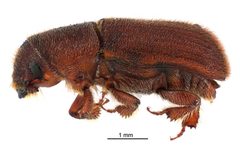
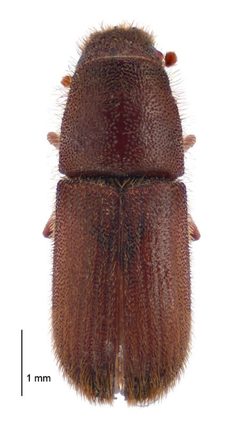
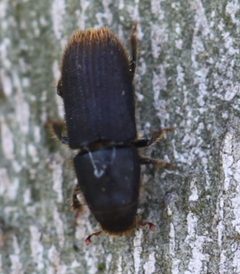
Males possess a stridulatory organ absent in females, enabling sound production. Acoustic monitoring can distinguish H. ligniperda from other wood-boring pests: feeding produces higher pulse counts (27.00 ± 22.31) and peak frequencies (3208.25 ± 783.62 Hz) compared to crawling , and significantly differs from Buprestidae in spectral and temporal parameters. Visual identification relies on standard bark beetle within Scolytinae; specific diagnostic features require examination.
Images
Habitat
Pine forests, primarily colonizing roots and lower trunk sections of trees. In Pinus thunbergii, occupies root sections up to 1 m depth, with spatial distribution shifting deeper into roots as host tree health declines.
Distribution
Native to Europe (Austria, Belarus, Belgium, Bosnia-Herzegovina, Croatia, Cyprus, Czech Republic, Denmark, Estonia, Finland, France, Germany, Greece, Hungary, Italy, Latvia, Lithuania, Macedonia, Moldova, Montenegro, Netherlands, Norway, Poland, Portugal, Russia, Serbia, Slovakia, Slovenia, Spain, Sweden, Switzerland, UK, Ukraine). Introduced to Asia (China, India, Japan, Sri Lanka, Turkey), Africa (Morocco, South Africa, Saint Helena, Swaziland, Tunisia), North America (USA: California, New York), South America (Brazil, Chile, Uruguay), and Oceania (Australia, New Zealand).
Diet
Feeds on phloem and inner bark of pine trees (Pinus spp.). Associated bacteria assist in degrading terpenoids and other toxic secondary metabolites of trees.
Host Associations
- Pinus spp. - primary Primary ; includes P. thunbergii, P. radiata, and other pine
- Ophiostomatoid fungi - mutualistic Includes six : Ceratocystiopsis, Graphilbum, Hawksworthiomyces, Leptographium, Masuyamyces, Ophiostoma; six new described from China. Fungi facilitate and invasion success
- Rahnella perminowiae - gut endosymbiontCore culturable gut bacterium; increases abundance during cold periods, produces and at low temperatures, reduces time by 20.9 days when fed on converted diet at 5°C
- Serratia marcescens - gut endosymbiontCore culturable gut bacterium; in bacterial
- Hafnia psychrotolerans - gut endosymbiontCore culturable gut bacterium involved in temperature
- Bursaphelenchus tusciae - Reported in Tunisia; serves as or for this
- Cryphalus sp. - co-occurringCo-occurs on same trees; occupies entire trunk, minimal competition due to spatial segregation
- Arhopalus rusticus - co-occurringCo-occurs on same trees; concentrated in lower-middle trunk and root section to 1 m depth
- Shirahoshizo sp. - co-occurringCo-occurs on same trees; distribution pattern less defined
Life Cycle
Complete with four larval instars and pupal stage. Laboratory rearing indicates minimum time of 72 days. Females lay average of 30.9 . Six continuous generations produced in laboratory conditions using artificial diet.
Behavior
Males produce stridulatory sounds in two contexts: during courtship and when disturbed. Acoustic signals are single-noted with modified spectro-temporal parameters based on behavioral context; physical interactions more strongly affect call parameters than acoustic signals from nearby males. Females do not produce stridulatory sounds. Feeding and crawling activities produce distinct acoustic signatures detectable via acoustic monitoring.
Ecological Role
forest pest causing devastating damage to pine trees. Primary colonizer of roots, becoming more during later stages of tree decline. Facilitates ophiostomatoid fungal , which in turn supports invasion success. Minimal competitive overlap with co-occurring wood-boring insects due to spatial resource partitioning.
Human Relevance
pest of major concern for international trade in wood products and logs. Exported logs require with methyl bromide; research ongoing to identify alternative treatments. Subject of acoustic monitoring development for early non-destructive detection of cryptic . Potential target for microbe-targeted control strategies based on gut bacterial manipulation.
Similar Taxa
- Buprestidae (jewel beetles)Co-occurring wood-boring pests; distinguishable by acoustic parameters: H. ligniperda exhibits higher pulse count, peak frequency (3208 Hz vs. 1291 Hz), and distinct amplitude patterns during feeding
- Cryphalus sp.Co-occurring bark beetle on Pinus; distinguishable by spatial distribution—Cryphalus occupies entire trunk while H. ligniperda primarily targets roots
- Arhopalus rusticusCo-occurring wood-borer; distinguishable by use—A. rusticus concentrated in lower-middle trunk and upper root section, with limited spatial overlap
More Details
Acoustic Communication
Males exhibit in stridulatory apparatus. Call variations occur primarily in spectral domain (centroid and maximum frequencies largest contributors to variability). Hierarchical clustering indicates physical interactions more important than acoustic stimulation in modifying call parameters.
Bacterial Community Structure
harbor highest bacterial diversity and richness, followed by gut, with prothorax lowest. : Proteobacteria, Firmicutes, Actinobacteriota. Functional prediction indicates enrichment in terpenoid backbone biosynthesis, aromatic compound degradation, and limonene/pinene degradation—functions likely assisting and detoxification.
Climate Change Vulnerability
Highly suitable projected to decline under future climate scenarios despite overall suitable habitat remaining stable. Precipitation significantly influences distribution and interactions with natural enemies (Platysoma lineare, Thanasimus formicarius, Platysoma oblongum).
Sources and further reading
- BugGuide
- GBIF taxonomy match
- iNaturalist taxon
- NCBI Taxonomy
- Catalogue of Life
- Hylurgus ligniperda . [Distribution map].
- Acoustic communication of the red‐haired bark beetle Hylurgus ligniperda
- Bursaphelenchus tusciae in Tunisia associated with Hylurgus ligniperda
- Ophiostomatoid fungi associated with Hylurgus ligniperda, including six new species from eastern China
- Gut Bacteria Strategies of Hylurgus ligniperda F. (Coleoptera Scolytidae) in Adapting to Temperature Changes
- ACOUSTIC MONITORING OF FOREST PESTS HYLURGUS LIGNIPERDA FABRICIUS AND BUPRESTIDAE IN PINUS THUNBERGII PARL.
- Ecological Niche Studies on Hylurgus ligniperda and Its Co-Host Stem-Boring Insects
- Survey of Ophiostomataceae associated with Hylurgus ligniperda (Curculionidae: Scolytinae) in New Zealand
- Supplementary material 2 from: Xie D, Chen H, Jia N, Niu F, Wang X, Yu J, Chi D (2025) Ophiostomatoid fungi associated with Hylurgus ligniperda, including six new species from eastern China. IMA Fungus 16: e169382. https://doi.org/10.3897/imafungus.16.169382
- Life cycle and massrearing of <i>Hylurgus ligniperda</i> using a novel eggcollection method
- Chromosomal-level genome assembly of Hylurgus ligniperda: insights into host adaptation and environmental tolerance
- Fungi associated with the red-haired bark beetle, Hylurgus ligniperda (Coleoptera: Curculionidae) in the forest-steppe zone in eastern Ukraine
- The role of climate change in shaping the distribution patterns of Hylurgus ligniperda and its key natural enemies
- Composition and Diversity of the Endobacteria and Ectobacteria of the Invasive Bark Beetle Hylurgus ligniperda (Fabricius) (Curculionidae: Scolytinae) in Newly Colonized Areas
- Prediction of the global potential geographical distribution of Hylurgus ligniperda using a maximum entropy model
- Improved YOLOv7 enhances identification of Hylurgus ligniperda in traps.
- Integrated Management Strategies for Wood Infested by Hylurgus ligniperda F. (Coleoptera: Curculionidae: Scolytinae).