
Hylurgus
Latreille, 1806
red-haired bark beetles
Species Guides
1- Hylurgus ligniperda(Goldenhaired Bark Beetle)
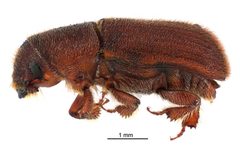
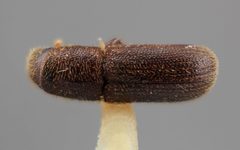
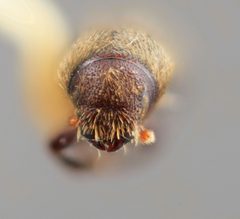
Hylurgus is a of bark beetles in the Curculionidae, Scolytinae. The genus includes economically significant forestry pests, most notably Hylurgus ligniperda (red-haired bark ), which is native to Eurasia and has established on multiple continents. in this genus are associated with coniferous , particularly Pinus species, and maintain complex symbiotic relationships with fungi and bacteria that facilitate host and environmental .
Pronunciation
How to pronounce Hylurgus: //hɪˈlɜːrɡəs//
These audio files are automatically generated. While they are not always 100% accurate, they are a good starting point.
Images
Habitat
Coniferous forests; specifically associated with pine trees (Pinus spp.) including stumps, bark, and phloem tissue. Gallery systems constructed in cambial region of trees.
Distribution
Native to Eurasia; established on every continent where pines occur including North America, South America, Oceania (Australia, New Zealand), Asia (China, Japan), and Africa (South Africa, Morocco, Tunisia).
Diet
Phloem tissue of Pinus . Hylurgus ligniperda specifically feeds on phloem of Pinus thunbergii and other pine species.
Host Associations
- Pinus spp. - primary phloem and cambial feeding
- Pinus thunbergii - specifically documented for H. ligniperda
- Pinus radiata - documented in New Zealand
Life Cycle
→ larva (four instars) → pupa → . time minimum 72 days under laboratory conditions. Hylurgus ligniperda: females lay average of 30.9 eggs; time and adult body mass affected by gut bacterial associates.
Behavior
Bores into bark and constructs galleries in phloem tissue. used during mating; males produce stridulatory sounds, females do not. Males modify call parameters based on physical interactions rather than acoustic stimulation from other males. Gut undergoes dynamic in response to temperature changes.
Ecological Role
Major biotic driver of tree mortality in coniferous forests. Reduces vitality of native pine forests, impairs windbreak and sand-fixation capacity in coastal shelterbelts. for ophiostomatoid fungi including Ceratocystiopsis, Graphilbum, Hawksworthiomyces, Leptographium, Masuyamyces, and Ophiostoma . Associated with including Bursaphelenchus tusciae.
Human Relevance
Significant forestry pest of concern. Infested logs require with methyl bromide for export. Subject of integrated management research and development of microbe-targeted control strategies. Acoustic monitoring methods developed for early detection.
Similar Taxa
- DendroctonusBoth are scolytine bark beetles associated with conifers; Hylurgus distinguished by red setae on and pronotum in H. ligniperda, and different gallery patterns
- IpsBoth colonize pine bark; Hylurgus lacks the characteristic declivity spines of Ips and has different fungal associations
More Details
Microbial symbioses
Maintains complex bacterial including Rahnella perminowiae, Serratia marcescens, and Hafnia psychrotolerans that facilitate temperature and nutrient conversion. Associated with diverse ophiostomatoid fungal communities that vary by geographic region and differ between gallery-derived versus trap-collected individuals.
Acoustic characteristics
Hylurgus ligniperda produces acoustic signals distinguishable from Buprestidae: higher pulse count (27.00 ± 22.31), peak amplitude (-37.34 ± 3.40 dB), and peak frequency (3208.25 ± 783.62 Hz) during feeding. Feeding and crawling produce distinct acoustic signatures.
Sources and further reading
- BugGuide
- Wikipedia
- GBIF taxonomy match
- iNaturalist taxon
- NCBI Taxonomy
- Catalogue of Life
- Hylurgus ligniperda . [Distribution map].
- Acoustic communication of the red‐haired bark beetle Hylurgus ligniperda
- Gut Bacteria Strategies of Hylurgus ligniperda F. (Coleoptera Scolytidae) in Adapting to Temperature Changes
- Bursaphelenchus tusciae in Tunisia associated with Hylurgus ligniperda
- Ophiostomatoid fungi associated with Hylurgus ligniperda, including six new species from eastern China
- ACOUSTIC MONITORING OF FOREST PESTS HYLURGUS LIGNIPERDA FABRICIUS AND BUPRESTIDAE IN PINUS THUNBERGII PARL.
- Supplementary material 2 from: Xie D, Chen H, Jia N, Niu F, Wang X, Yu J, Chi D (2025) Ophiostomatoid fungi associated with Hylurgus ligniperda, including six new species from eastern China. IMA Fungus 16: e169382. https://doi.org/10.3897/imafungus.16.169382
- Life cycle and massrearing of <i>Hylurgus ligniperda</i> using a novel eggcollection method
- Chromosomal-level genome assembly of Hylurgus ligniperda: insights into host adaptation and environmental tolerance
- Fungi associated with the red-haired bark beetle, Hylurgus ligniperda (Coleoptera: Curculionidae) in the forest-steppe zone in eastern Ukraine
- Survey of Ophiostomataceae associated with Hylurgus ligniperda (Curculionidae: Scolytinae) in New Zealand
- Prediction of the global potential geographical distribution of Hylurgus ligniperda using a maximum entropy model
- The role of climate change in shaping the distribution patterns of Hylurgus ligniperda and its key natural enemies
- Composition and Diversity of the Endobacteria and Ectobacteria of the Invasive Bark Beetle Hylurgus ligniperda (Fabricius) (Curculionidae: Scolytinae) in Newly Colonized Areas
- Supplementary material 15 from: Xie D, Chen H, Jia N, Niu F, Wang X, Yu J, Chi D (2025) Ophiostomatoid fungi associated with Hylurgus ligniperda, including six new species from eastern China. IMA Fungus 16: e169382. https://doi.org/10.3897/imafungus.16.169382
- Improved YOLOv7 enhances identification of Hylurgus ligniperda in traps.
- Integrated Management Strategies for Wood Infested by Hylurgus ligniperda F. (Coleoptera: Curculionidae: Scolytinae).