
Coccotrypes dactyliperda
(Fabricius, 1802)
date stone beetle, button beetle, palm seed borer
Coccotrypes dactyliperda is a small scolytine weevil (1.8–2.3 mm) that spends nearly its entire inside palm seeds, particularly those of date palms (Phoenix dactylifera). Native to Africa and the Middle East, it has achieved distribution through international trade in dates and horticultural palm seeds. The is a significant agricultural pest, causing 20–40% yield losses in unprotected date plantations by attacking green, unripe fruit and causing premature fruit drop. It employs a haplodiploid sex-determination system with extensive inbreeding, enabling rapid growth within individual seeds that can support 70–80 beetles through multiple overlapping .
Pronunciation
How to pronounce Coccotrypes dactyliperda: //ˌkɒkkoʊˈtraɪpiːz dæktɪlɪˈpɜːrdə//
These audio files are automatically generated. While they are not always 100% accurate, they are a good starting point.
Identification
Distinguished from other scolytines by its exclusive association with palm seeds and minute size. The round penetration hole (~1 mm diameter) in date seeds is diagnostic. Similar to Callosobruchus chinensis in general appearance and preferences, but C. dactyliperda attacks unripe green fruit while C. chinensis infests ripe or stored legumes. C. dactyliperda's haplodiploid produces strongly female-biased sex ratios (85–93% female), unlike relatives. The convex, hairy surface and specific association with Phoenix separate it from other Coccotrypes species.
Images
Appearance
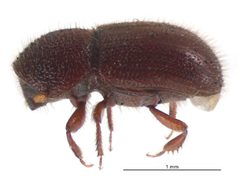
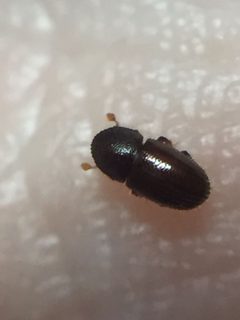
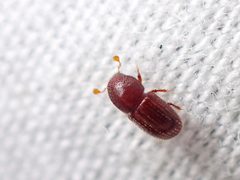
are reddish-brown to black-brown, convex, and hairy on the surface. Body length ranges 1.8–2.3 mm (0.07–0.09 in), width approximately 0.7–1 mm. The body form is compact and rounded, typical of seed-boring beetles. Like all beetles, possesses hardened forewings () protecting membranous hindwings used for , though flight is rarely employed.
Habitat
Strictly cryptic, inhabiting the interior of palm seeds throughout development. Natural includes seeds of wild and cultivated date palms (Phoenix dactylifera), Canary Island date palms (P. canariensis), and doum palms (Hyphaene thebaica). Also documented in seeds of Washingtonia robusta and experimentally in hazelnuts (Corylus avellana) and vegetable ivory (Phytelephas spp.). Occurs in subtropical and temperate zones wherever palms grow; cavernicolous reported in Trinidad. Requires seeds with sufficient albumen (endosperm) to support development.
Distribution
Originally to the Middle East and North Africa; now in subtropical and temperate zones. Present throughout date-growing regions including the Jordan Valley, Egypt, and arid regions of Israel. Established in the Americas, including the Galápagos Islands and Brazil (Minas Gerais, São Paulo). Dispersed globally via trade in date fruits for consumption and distribution of palm seeds for horticulture, particularly Phoenix canariensis and vegetable ivory (Phytelephas) for button manufacture since the 19th century.
Seasonality
In northern hemisphere date palm groves, peak fruit drop occurs in late July, with activity declining sharply as fruit ripens. First females emerge from hibernation in late June to early July. Hibernation is initiated by temperatures at or below 15°C combined with reduced ; terminated by temperatures above 25°C with longer photoperiods. In southern hemisphere, occurs late December to early January. Multiple overlapping generations may occupy a single seed from through late summer.
Diet
Exclusively spermatophagous; larvae and consume the albumen (endosperm) of palm seeds. A single date seed provides sufficient nutrition for 70–80 beetles through multiple . No feeding occurs outside the seed; adults do not feed on fruit pericarp or other plant tissues. Experimental studies indicate individual beetles may show preferences for different seed types, though natural diet is restricted to palm seeds.
Host Associations
- Phoenix dactylifera - primary Date palm; main agricultural , green unripe fruit attacked
- Phoenix canariensis - primary Canary Island date palm; penetration occurs at groove
- Hyphaene thebaica - Doum palm
- Washingtonia robusta - Mexican fan palm
- Phytelephas spp. - Tagua palms; vegetable ivory used for button manufacture
Life Cycle
Entire completed inside a single seed. After , mated females lay 3–5 days post-penetration. Egg incubation averages 5.9 days at 28°C; larval duration 12–15 days; pupal development 4 days. Total development from egg to : 22.1 days (males) to 24.8 days (females) at 28°C; 49 days for females at 20°C. Unfertilized females produce haploid male offspring by arrhenotokous ; mated females produce offspring of both sexes. Females mate with first mature son, then typically consume male offspring. Overlapping occur with multiple females reproducing simultaneously in crowded seeds. When seed resources are exhausted, females disperse to establish new galleries. Mated females live average 73 days; unmated females 63 days. Neither eggs nor larvae survive if ejected from the gallery.
Behavior
Females locate seeds primarily by crawling up palm stems and along inflorescences rather than flying; occurs only when crowded or disturbed, with documented up to 50 m. Dispersal duration brief (4–48 hours in laboratory). Once emerged, beetles are photophilic—attracted to light sources and crawling faster toward light (3.50 mm/s) than in darkness—though from seeds preferentially occurs at night. Seed penetration is biomechanically sophisticated: beetles overwhelmingly select the groove of seeds for traction, using hind legs for thrust, mid legs as pivot points and wall anchors in tunnels, and fore legs for lateral control. Tunneling proceeds in circular fashion with 1/8 to 1/4 turns clockwise or counter-clockwise. cues prevent tunneling completely through seeds. Penetration of date seeds requires 2.75–8 hours depending on moisture content; harder seeds reduce debris production and extend tunneling intervals. females provide parental care including , rolling, and likely salivary secretions; eggs tended by multiple females in some cases. Removal of females results in egg mortality from mold and desiccation.
Ecological Role
Major pest of date palm agriculture, causing 20–40% yield losses in unprotected plantations by inducing premature abscission of green fruit. Reduces palm recruitment success by destroying seeds and preventing germination; damaged seeds that do germinate exhibit reduced energy for cotyledonary petiole growth. Facilitates secondary seed by other organisms—rodents and other vertebrates consume pericarp of -infested fallen dates, and subsequent by birds, canids, and ursids aids beetle of new areas. Survival rate through vertebrate digestion is high due to single small penetration hole limiting exposure to gastric fluids.
Human Relevance
Significant economic pest of date production globally, particularly in Israel, Egypt, and Jordan Valley operations. Fruit drop in late July reduces both yield and fruit quality. Control methods include mechanical protection with dense netting bunch covers (avoiding chemical side effects) and (requiring multiple seasonal applications). Historical spread facilitated by vegetable ivory trade for button manufacture, giving rise to 'button .'
Similar Taxa
- Callosobruchus chinensisSimilar body size, preferences, and seed-boring ; distinguished by association (legumes vs. palms), ( vs. haplodiploid), and fruit stage attacked (ripe vs. unripe). Reproductive interference documented between .
- Nitidulid beetles (Carpophilus spp.)Other date palm pests; distinguished by attacking ripe rather than unripe fruit, causing rot rather than abscission, and belonging to different (Nitidulidae vs. Curculionidae).
More Details
Reproductive biology
The exhibits cooperative breeding traits supported by extreme inbreeding and high relatedness within galleries. Inbred colonies show higher reproductive success than outbred colonies despite equivalent numbers, attributed to better egg care, reduced , or greater viability. Females can distinguish males from same versus different , preferring related mates.
Dispersal vectors
Vertebrate-mediated is significant: 10% of ground seeds infested at end of breeding season (October), rising to 95% by March following hibernation and first . Canids, ursids, fruit bats, and birds consume dates and defecate or eject viable seeds with beetles intact. Beetles survive short exposure to saliva, gastric acid, and intestinal fluids.
Sources and further reading
- BugGuide
- Wikipedia
- GBIF taxonomy match
- iNaturalist taxon
- NCBI Taxonomy
- Catalogue of Life
- Global distribution of the date stone beetle, Coccotrypes dactyliperda (Coleoptera: Curculionidae, Scolytinae)
- Patterns of Seed Penetration by the Date Stone Beetle Coccotrypes dactyliperda (Coleoptera, Curculionidae, Scolytinae)
- Photosensitivity of Dispersing Cryptic Date Stone Beetles Coccotrypes dactyliperda (Coleoptera, Curculionidae, Scolytinae)—A Pilot Study
- Biology, ecology and distribution of the Date Stone Beetle,Coccotrypes dactyliperda(Coleoptera: Curculionidae)
- Population density and host preference of the date stone beetle, Coccotrypes dactyliperda (Coleoptera, Curculionidae, Scolytinae) in date palm farms as well as the efficacy of some trap attractants in Sharkia Governorate, Egypt