
Coccotrypes
Eichhoff, 1878
Species Guides
5- Coccotrypes advena(seed borer)
- Coccotrypes carpophagus
- Coccotrypes cyperi(seed borer)
- Coccotrypes dactyliperda(date stone beetle)
- Coccotrypes distinctus
Coccotrypes is a of bark beetles (Curculionidae: Scolytinae) comprising approximately 130 described . The genus is notable for its specialized seed-boring habits, with several species developing entirely within seeds or of plants. Coccotrypes dactyliperda (date stone ) and C. rhizophorae are economically significant pests of date palms and mangroves respectively, having achieved distributions through human-mediated of host plant material.
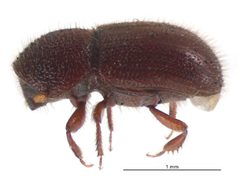
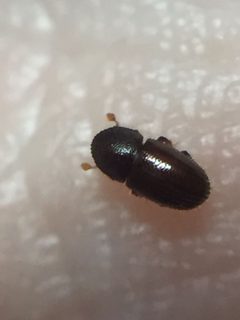
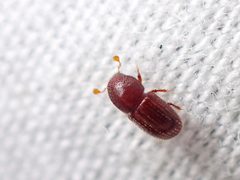
Pronunciation
How to pronounce Coccotrypes: /ˈkɒk.kəˌtraɪps/
These audio files are automatically generated. While they are not always 100% accurate, they are a good starting point.
Images
Habitat
within Coccotrypes occupy diverse determined by associations: C. dactyliperda occurs inside seeds of Phoenix palms in date palm-growing regions and horticultural settings; C. rhizophorae inhabits mangrove forests where it develops within Rhizophora . The as a whole is associated with seeds, stones, or propagules of various host plants.
Distribution
The has broad distribution through human-mediated . C. dactyliperda is native to the Middle East and North Africa, now in subtropical and temperate zones worldwide. C. rhizophorae is native to Indonesia, introduced to Ecuador, the Galápagos Islands, and various American countries. Distribution records for the genus exist from Norway and Sweden.
Human Relevance
C. dactyliperda causes 20–40% production losses in unprotected date palms and damages seeds intended for horticultural propagation. C. rhizophorae is the principal pest of mangrove in Rhizophora, causing mortality that affects mangrove forest management, conservation, and restoration efforts in Ecuador and other invaded regions.
Sources and further reading
- BugGuide
- Wikipedia
- GBIF taxonomy match
- iNaturalist taxon
- NCBI Taxonomy
- Catalogue of Life
- Global distribution of the date stone beetle, Coccotrypes dactyliperda (Coleoptera: Curculionidae, Scolytinae)
- Patterns of Seed Penetration by the Date Stone Beetle Coccotrypes dactyliperda (Coleoptera, Curculionidae, Scolytinae)
- Evaluation of Coccotrypes rhizophorae on propagules of species of the genus Rhizophora on the Ecuadorian coast Evaluación de Coccotrypes rhizophorae en propágulos de especies del género Rhizophora en la costa ecuatoriana
- Evaluation of the damage caused by Coccotrypes rhizophorae in Rhizophora propagules along the Ecuadorian coast
- Photosensitivity of Dispersing Cryptic Date Stone Beetles Coccotrypes dactyliperda (Coleoptera, Curculionidae, Scolytinae)—A Pilot Study
- Biology, ecology and distribution of the Date Stone Beetle,Coccotrypes dactyliperda(Coleoptera: Curculionidae)
- Population density and host preference of the date stone beetle, Coccotrypes dactyliperda (Coleoptera, Curculionidae, Scolytinae) in date palm farms as well as the efficacy of some trap attractants in Sharkia Governorate, Egypt
- Propágulos de Rhizophora mangle (Rhizophoraceae) barrenados por Coccotrypes rhizophorae (Coleoptera: Curculionidae) en el manglar de Tumilco, Veracruz, México