
Cryphalus pubescens
Hopkins, 1915
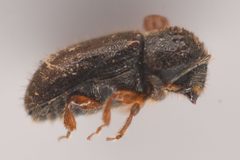
Cryphalus pubescens is a small bark beetle in the Curculionidae, Scolytinae. It is one of approximately 200 in the Cryphalus, a group of ambrosia and bark beetles distributed worldwide. The species was described by Hopkins in 1915 and is known from North America, with records from British Columbia and the United States. Like other cryphaline beetles, it is associated with woody plants, though specific associations remain poorly documented.
Pronunciation
How to pronounce Cryphalus pubescens: //ˈkɹaɪ.fəl.əs pjuːˈbɛs.ɛnz//
These audio files are automatically generated. While they are not always 100% accurate, they are a good starting point.
Identification
Members of Cryphalus are minute to small bark beetles, typically 1.5–3 mm in length, with a rounded pronotum and short, clubbed . Cryphalus pubescens can be distinguished from by the presence of dense (fine hairs) on the body, as indicated by its specific epithet. The are typically short, exposing the . Accurate identification to requires examination of microscopic characters including the arrangement of setae on the declivity ( slope of the elytra) and the form of the male genitalia.
Images
Habitat
Found in forested environments, particularly in association with coniferous or hardwood trees. Specific microhabitat preferences are not well documented, but related in the inhabit the inner bark or phloem of dead, dying, or stressed trees.
Distribution
North America. Documented from British Columbia, Canada, and the United States. The precise range within North America is incompletely known due to the small size of the and limited targeted survey efforts.
Diet
Phloeophagous (feeds on phloem and inner bark of trees). Specific tree are not documented in the available literature.
Behavior
Like other bark beetles in the Scolytinae, likely tunnel through bark to reach the phloem layer where they feed and reproduce. Males and females may cooperate in gallery construction. The may exhibit ambrosia beetle tendencies, cultivating fungal gardens for larval nutrition, as seen in some related Cryphalus species, though this has not been confirmed for C. pubescens specifically.
Ecological Role
As a phloeophagous bark beetle, it contributes to the decomposition of dead and dying wood, facilitating nutrient cycling in forest . It may also serve as prey for woodpeckers, , and other insect . Its role as a tree mortality agent is likely minor compared to more aggressive bark beetle .
Human Relevance
No significant documented economic impact. Not known to be a major pest of forestry or agricultural crops. Its small size and cryptic habits make it unlikely to be noticed except by collectors.
Similar Taxa
- Cryphalus fulvusSimilar size and general ; distinguished by differences in setal patterns on the elytral declivity and degree of .
- Cryphalus asperatusOverlapping distribution in North America; C. pubescens differs in having denser, more uniform and subtle differences in antennal club structure.
- Hypothenemus speciesSimilar minute size and bark beetle habitus; Hypothenemus typically have a more elongated body form and different pronotal .