
Otiorhynchus singularis
(Linnaeus, 1767)
Clay-coloured Weevil
Otiorhynchus singularis, the clay-coloured weevil, is a European native weevil that has been introduced to North America and the Azores. feed on buds, shoots, and leaves of various woody plants, with documented damage to conifers, fruit bushes, and hops. The is parthenogenetic, with females producing viable without mating. It is primarily and can be a significant pest in horticultural and forestry settings.
Pronunciation
How to pronounce Otiorhynchus singularis: /ˌoʊtiˈɔrɪŋkəs ˌsɪŋɡjʊˈlɛrɪs/
These audio files are automatically generated. While they are not always 100% accurate, they are a good starting point.
Identification
Distinguished from the vine weevil (O. sulcatus) and strawberry root weevil (O. ovatus) by its clay-brown coloration and specific elyral sculpturing, though variation makes reliable field identification difficult. Examination of genitalia or expert verification is often required for definitive identification. Differs from Phyllobius and Polydrusus by the position of antennal insertion on the rostrum and overall body proportions.
Images
Appearance
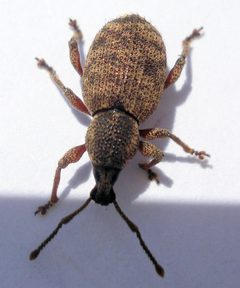
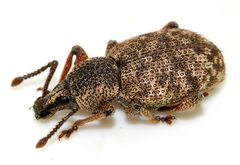
are clay-coloured to brown weevils with a compact, oval body form typical of the . The bear distinct longitudinal grooves (). Like all Otiorhynchus , they possess a pronounced rostrum (snout) with elbowed, clubbed inserted partway along its length. Colour and can vary considerably between individuals, complicating identification.
Habitat
Found in gardens, orchards, hop yards, conifer plantations, and natural woodland edges. Associated with the root zones of plants where larvae develop in soil.
Distribution
Native to Europe; introduced and established in British Columbia (Canada), Connecticut (USA), and the Azores (São Miguel). European records span from western to eastern regions.
Seasonality
are active from spring through autumn, with peak activity during warmer months. feeding habits mean adults are most commonly encountered after dusk.
Diet
feed on buds, young shoots, and leaves of currants, gooseberries, raspberries, hops, firs, and Norway spruce. Larvae feed on roots in soil; specific larval range is poorly documented but presumed to overlap with adult hosts.
Host Associations
- Ribes spp. - feeds oncurrants and gooseberries
- Rubus idaeus - feeds onraspberry
- Humulus lupulus - feeds onhops
- Abies spp. - feeds onfir trees
- Picea abies - feeds onNorway spruce
Life Cycle
Reproduces parthenogenetically; females lay in soil near plants. Larvae are soil-dwelling, feeding on roots, and pupate in the soil. Development likely spans one year, with emerging in spring, though specific timing varies by region.
Behavior
. hide in soil or debris at the base of plants during daylight hours. When disturbed, adults drop to the ground and feign death. Adults are flightless.
Ecological Role
Acts as a folivore and root herbivore, capable of causing measurable damage to cultivated plants and young conifers. Soil-dwelling larvae contribute to nutrient cycling through root decomposition.
Human Relevance
Recognized agricultural and horticultural pest, particularly damaging to soft fruit bushes, hops, and conifer nursery stock. Damage includes defoliation, bud destruction, and bark chewing. Introduced in North America represent an of economic concern.
Similar Taxa
- Otiorhynchus sulcatusVine weevil shares similar body form and habits but typically darker (black) with more pronounced punctation on ; both are parthenogenetic root-feeding pests.
- Otiorhynchus ovatusStrawberry root weevil is smaller with different rostral proportions and elyral ; also parthenogenetic and .
- Phyllobius spp.Distinguished by antennal insertion near rostral tip rather than midpoint, and typically more metallic coloration.
- Polydrusus spp.Generally more brightly coloured (metallic greens/blues) with different antennal club structure and activity pattern.
More Details
Parthenogenesis
Like several , O. singularis reproduces via . consist entirely of females, and males are unknown or extremely rare. This reproductive mode facilitates rapid population establishment in introduced ranges.
Diagnostic challenges
Significant intraspecific variation in colour and body proportions, combined with overlapping characters with related , makes O. singularis difficult to identify from photographs or field observations alone. Voucher specimens and expert determination are recommended for reliable records.