
Otiorhynchus sulcatus
(Fabricius, 1775)
black vine weevil, vine weevil, strawberry weevil, cyclamen weevil
Otiorhynchus sulcatus is a parthenogenetic weevil native to the Palearctic region that has become a globally significant horticultural pest. are flightless, , and feed on foliage, producing characteristic notching damage along leaf margins. Larvae develop belowground, feeding on roots, corms, and rhizomes, causing severe plant damage or death. The reproduces exclusively through ; males are absent from all . Adults exhibit strong visual and thigmotactic preferences for selection, favoring dark colors (black, blue), tall silhouettes, and basal entrance openings.

Pronunciation
How to pronounce Otiorhynchus sulcatus: /ˌɔtiˈoʊrɪŋkəs ˈsʌlkətəs/
These audio files are automatically generated. While they are not always 100% accurate, they are a good starting point.
Identification
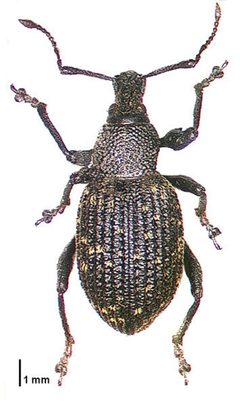
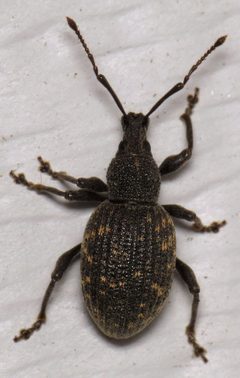
are distinguished from similar Otiorhynchus by the combination of: flightlessness ( , no hind wings); matte black to dark brown coloration; distinct longitudinal grooves () on the elytra; short, broad rostrum with elbowed, clubbed ; and approximately 8-11 mm body length. The elytral grooves are a key diagnostic feature referenced in the specific epithet. Adults cannot be reliably distinguished from O. ovatus by external alone; accurate separation requires examination of genitalia or molecular markers. Larvae are creamy white, C-shaped, legless with brown capsules, typical of Curculionidae but requiring molecular or rearing-based identification for species-level determination.
Images
Habitat
Found in cultivated environments including soft-fruit plantations (strawberry), ornamental nurseries, gardens, and greenhouse operations. require soil or substrate for -seeking . In naturalized , occurs in woodland edges, hedgerows, and riparian vegetation with suitable plants. Laboratory studies indicate activity at 20°C with 60% relative humidity; field activity is and temperature-dependent.
Distribution
Native to Palearctic Europe; introduced and established across North America (USA, Canada), New Zealand, Australia (Tasmania), Chile, Japan, and St. Helena. Within North America, recorded from Alaska to California and across the eastern states; in Europe, widespread from Scandinavia to the Mediterranean.
Seasonality
are active from late spring through autumn in temperate regions; peak activity varies with latitude. foraging occurs during warm, humid nights. occurs as larvae in soil or as adults in protected . Laboratory-reared adults maintained for at least one month demonstrate reproductive activity, suggesting adults can survive extended periods.
Diet
feed on foliage of diverse angiosperms and gymnosperms, with documented consumption of: strawberry (Fragaria × ananassa), yew (Taxus baccata), spindle tree (Euonymus fortunei), rhododendron (Rhododendron catawbiense), spruce (Picea spp.), and ivy (Hedera helix). Feeding causes semicircular notching of leaf margins. Larvae feed exclusively on belowground plant tissues: roots, corms, rhizomes, and lower stems.
Host Associations
- Fragaria × ananassa - and larval optimal for survival, , and larval establishment
- Taxus baccata - preferred food in laboratory; poor larval
- Picea abies - poor ; greatly extended preoviposition time and reduced viability
- Picea glauca - poor for O. sulcatus (contrast with O. ovatus)
- Rhododendron catawbiense - poor poor larval establishment for both
- Euonymus fortunei - field for production studies
- Hedera helix - non- attractionattracted to damaged leaves despite not being a field
- Prunus laurocerasus - non- attractionattracted to damaged leaves despite not being a field
- Cyclamen - and larval common greenhouse
Life Cycle
Development includes , larval (multiple instars), pupal, and stages. Eggs are laid in soil around plant bases by parthenogenetic females. Larvae pass through at least six instars (L2 and L6 specifically referenced in developmental studies); development occurs belowground. occurs in soil . Adults emerge as individuals, harden, and disperse to foliage. time varies with temperature; at 23°C, complete cycle in 120 hours, suggesting rapid larval development under optimal conditions. No males are produced; is obligate .
Behavior
foraging on plants; return to soil or dark at dawn. Strong thigmotactic and visual orientation: preferentially enter black or blue refuges over white, green, red, or yellow; select taller refuges (11.3 cm > 6 cm > 3 cm); and choose refuges with basal rather than entrance openings. Adults are attracted to , suggesting mediated by . Attraction to mechanically damaged leaves of both host and non-host plants indicates response to general plant volatiles. Adults can be dislodged from plants by mechanical disturbance at night.
Ecological Role
Significant economic pest in horticultural systems. feeding causes aesthetic damage to ornamental foliage; larval root feeding reduces plant vigor, yield, and survival. Single individuals can trigger crop rejection in commercial operations. Serves as for including Steinernema arenarium, which can complete development in larvae and has been investigated for . No known native ecological role in introduced range; functionally absent from as no males are produced and eliminates .
Human Relevance
Major pest of soft-fruit production (strawberry, raspberry) and ornamental horticulture (cyclamen, rhododendron, yew). Management relies on , , and cultural controls. Monitoring is complicated by and cryptic -seeking; research has focused on optimizing trap design using visual preferences. concerns in international plant trade. No human health significance.
Similar Taxa
- Otiorhynchus ovatussympatric in Pacific Northwest; external nearly identical; distinguished by genitalia, molecular markers, and preferences (O. ovatus performs better on Picea glauca)
- Otiorhynchus salicicolasexually reproducing ; attracted to of both , but O. salicicola uses different plants (ivy, cherry laurel)
- Other Otiorhynchus speciesnumerous flightless, parthenogenetic in require identification; elytral and genitalia critical for separation
Sources and further reading
- BugGuide
- GBIF taxonomy match
- iNaturalist taxon
- NCBI Taxonomy
- Home invaders III - Fall field cricket, Gryllus pennsylvanicus — Bug of the Week
- Otiorhynchus sulcatus . [Distribution map].
- Otiorhynchus sulcatus . [Distribution map].
- Optimising Vine Weevil, Otiorhynchus sulcatus F. (Coleoptera: Curculionidae), Monitoring Tool Design
- Oviposition Preference and Host Recognition by the Black Vine Weevil, Otiorhynchus sulcatus (Coleoptera: Curculionidae)
- Behavioural responses of the vine weevil, Otiorhynchus sulcatus, to semiochemicals from conspecifics, Otiorhynchus salicicola, and host plants
- Infection, development, and reproduction of the entomopathogenic nematode Steinernema arenarium (Nematoda: Steinernematidae) in the black vine weevil Otiorhynchus sulcatus (Coleoptera: Curculionidae)
- Fecundity, longevity and establishment of Otiorhynchus sulcatus (Fabricius) and Otiorhynchus ovatus (Linnaeus) (Coleoptera: Curculionidae) from the Pacific North‐west of the United States of America on selected host plants