
Otiorhynchus ovatus
(Linnaeus, 1758)
Strawberry Root Weevil
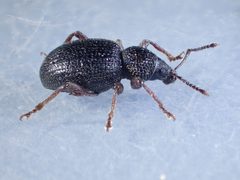
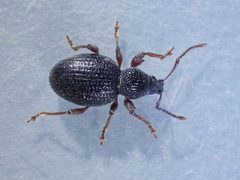
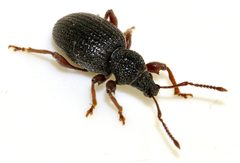
Otiorhynchus ovatus is a flightless weevil native to North America, occurring across Canada and the northern United States. The reproduces exclusively through —no males have ever been observed. feed nocturnally on leaves and stems of plants, while larvae feed on roots and crowns, causing significantly more damage. The species is a major agricultural pest of strawberries and other crops, with larvae capable of killing seedlings and young transplants.
Pronunciation
How to pronounce Otiorhynchus ovatus: //ˌoʊ.tɪ.oʊˈrɪŋ.kəs oʊˈvɑː.təs//
These audio files are automatically generated. While they are not always 100% accurate, they are a good starting point.
Identification
Distinguished from similar Otiorhynchus by its association with strawberry and other soft fruit crops. are small (6 mm), dark, and flightless with . The species can be separated from Otiorhynchus sulcatus (black vine weevil) by geographic origin and preferences—O. ovatus from the Pacific Northwest shows more consistent host selection across , while O. sulcatus exhibits variable host preferences geographically. Larvae are smaller than white and found in root zones rather than deeper soil layers.
Images
Habitat
Agricultural fields, plantations, and nurseries; also found in natural areas with suitable vegetation. shelter under stones or other protected places during winter. Larvae occur in soil near host plant roots, deep in soil.
Distribution
Canada and the northern United States; established in the Pacific Northwest of the United States. Records include Alaska, Alberta, and other northern regions.
Seasonality
active from spring through summer, joining previous year's adults to feed on leaves and fruit. laid in summer. Larvae feed until late fall, then hibernate. occurs in upper soil layers in spring, with adults emerging later in spring or summer.
Diet
feed nocturnally on leaves and stems, creating notches. Larvae feed on roots and crowns of plants. Documented include strawberry (Fragaria × ananassa), raspberry, rhododendron, grape, peppermint, and various grasses. Picea glauca 'Conica' supports larval development; Taxus baccata is a nonhost for both adults and larvae; Rhododendron catawbiense is a poor larval host.
Host Associations
- Fragaria × ananassa - primary optimal for both longevity and larval development; 'Totem' cultivar produced greatest and
- Picea glauca - larval 'Conica' cultivar best larval for O. ovatus in study
- Taxus baccata - nonhost and larvae cannot establish
- Rhododendron catawbiense - poor poor larval for both O. ovatus and O. sulcatus
- Picea abies - unsuitable for related O. sulcatus; O. ovatus not specifically tested
- Raspberry - feeding documented
- Grape - feeding documented
- Peppermint - feeding documented
- Grasses - feeding documented
Life Cycle
Overwinters as larvae deep in soil, or as under sheltered places. laid at random in soil around food plants during summer. Larvae hatch and feed on roots until late fall, then hibernate. occurs in upper soil layers in spring. Adults emerge later in spring or summer, joining previous year's adults. is parthenogenetic; no males exist.
Behavior
are flightless and disperse by . Adults feed nocturnally. Since adults cannot fly, damage spreads gradually from older plantings to bordering plants, expanding outward each year. occurs without mating through .
Ecological Role
Herbivore; larval root feeding can weaken or kill plants. In natural , impacts are limited by constraints due to flightlessness.
Human Relevance
Major agricultural pest threatening sub-tropical and temperate strawberry farming. Larval feeding on roots and crowns causes stunted growth, reddish curled leaves, wilting during fruit formation, and plant death. Damage results in shortened plant lifespan, poor yields, and revenue losses. cause minor notching damage to leaves and stems. Control methods include , crop , fall plowing of infested fields, cleaning farm equipment to prevent spread, and with variable results.
Similar Taxa
- Otiorhynchus sulcatusBoth are flightless, parthenogenetic root weevils of similar size and appearance. O. sulcatus exhibits geographically variable preferences, while O. ovatus shows more consistent host selection. O. sulcatus accepts Taxus as host; O. ovatus does not.
- White grubs (Scarabaeidae larvae)Both are C-shaped, white, soil-dwelling larvae feeding on roots. O. ovatus larvae are smaller (8 mm vs. larger scarab larvae), legless, and have darker ; found in upper root zone rather than deeper soil.
More Details
Parthenogenesis
O. ovatus reproduces through obligate . No male specimens have ever been observed in this .
Dispersal limitation
Flightlessness restricts natural , making this dependent on human-mediated transport for long-distance spread. Damage patterns in fields reflect this—border plants show damage first, with expansion outward over successive years.
Sources and further reading
- BugGuide
- Wikipedia
- GBIF taxonomy match
- iNaturalist taxon
- NCBI Taxonomy
- Drones Prove Optimal in Spreading Gall Insects to Control Invasive Trees in Hawai‘i
- Brachys on oak | Beetles In The Bush
- Fecundity, longevity and establishment of Otiorhynchus sulcatus (Fabricius) and Otiorhynchus ovatus (Linnaeus) (Coleoptera: Curculionidae) from the Pacific North‐west of the United States of America on selected host plants