
Otiorhynchus meridionalis
Gyllenhal, 1834
Lilac Root Weevil
Otiorhynchus meridionalis, commonly known as the lilac root weevil, is a broad-nosed weevil in the Curculionidae. It is a recognized landscape pest in North America, where it feeds on ornamental plants including lilac, euonymus, and peonies. The exhibits a with root-feeding larvae and leaf-feeding that produce characteristic notched damage. Adults are and occasionally enter buildings during hot weather. Native to Europe, it has established in western North America.
Pronunciation
How to pronounce Otiorhynchus meridionalis: //ˌoʊ.ti.oʊˈrɪŋ.kəs ˌmɛr.ɪ.diˈɒn.əl.ɪs//
These audio files are automatically generated. While they are not always 100% accurate, they are a good starting point.
Identification
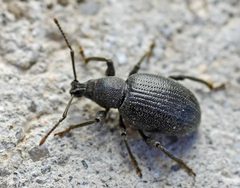
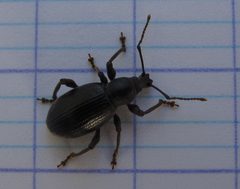
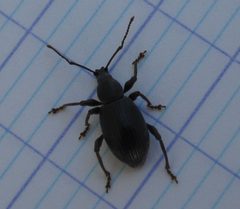
are identified by their small size (approximately 6 mm), shiny brownish-black coloration, prominent elongated rostrum, and geniculate . The characteristic feeding damage—U-shaped notches along leaf margins—provides a field indicator of presence. Differentiation from other Otiorhynchus root weevils (O. ovatus, O. rugostriatus, O. sulcatus) requires careful morphological examination, as these share similar body plans and habits. The species' association with lilac and other ornamental in North America provides contextual identification support.
Images
Habitat
Associated with ornamental landscapes and gardens where plants (lilac, euonymus, peonies) are cultivated. seek shaded, moist microhabitats during hot periods, which drives their occasional entry into buildings. Larval consists of soil and root zones of host plants.
Distribution
Native to Europe, with documented occurrence in France, Germany, Italy (Sicily), Netherlands, and Spain. Introduced and established in North America, with confirmed records from California, Colorado, Idaho, Montana, Nevada, New Mexico, Utah, and Washington.
Seasonality
are active during summer months and are . Peak indoor intrusion occurs during hot summer periods when adults seek shade and moisture.
Diet
Larvae feed on plant roots. feed on leaves, consuming tissue from the edges and producing U-shaped notches.
Host Associations
- Syringa vulgaris - Common North American ; referred to as 'lilac root weevil' based on this association.
- Euonymus - Ornamental plant.
- Paeonia - Ornamental plant.
- Fragaria ananassa - Strawberry; documented in distribution source.
- Malus domestica - Apple; documented in distribution source.
Life Cycle
Holometabolous development with distinct larval and stages. Larvae are soil-dwelling and feed on roots. Adults emerge and feed on foliage. Specific details regarding -laying, larval instars, , and stages are not documented in available sources.
Behavior
are strictly . During hot summer weather, adults exhibit wandering that leads to entry into human structures in search of shade and moisture. Adults are harmless to humans, pets, and furnishings. capability is absent or reduced in this and related Otiorhynchus , consistent with the brachypterous condition common in the .
Ecological Role
Herbivore in ornamental and agricultural systems. Larval root feeding and foliar feeding can stress plants, though damage is typically minor and not lasting on established lilac. and broader impacts are not documented.
Human Relevance
Recognized as a common landscape pest of ornamental plants. Economic impact is generally minor; damage to lilac is rarely lasting. Occasional nuisance pest when enter buildings during summer. Management through is recommended only for severe ; mechanical removal or is preferred for incidental individuals.
Similar Taxa
- Otiorhynchus ovatusShares root weevil habits, , and summer wandering behavior leading to indoor intrusion; morphologically similar and requires expert identification to distinguish.
- Otiorhynchus rugostriatusCongeneric root weevil with overlapping habits and preferences; similar body form and damage patterns.
- Otiorhynchus sulcatusBlack vine weevil; shares , root-feeding larvae, leaf-notching , and propensity for summer indoor wandering.
More Details
Taxonomic note
Catalogue of Life lists this as a synonym, but GBIF, NCBI, and iNaturalist treat it as accepted. The accepted status is followed here based on consensus among active biodiversity databases.
Wing reduction
Like many Otiorhynchus , O. meridionalis likely exhibits wing reduction (brachyptery), contributing to its limitation and reliance on human-mediated transport for range expansion.