
Naupactus leucoloma
Boheman, 1840
white-fringed weevil, white-fringed beetle
Naupactus leucoloma is a broad-nosed weevil native to South America that has become a globally distributed agricultural pest. are flightless, parthenogenetic females outside their native range, with males occurring only rarely in Argentina, Uruguay, and southern Brazil. The is notable for its extreme polyphagy, having been documented feeding on over 385 plant species. Larval root-feeding causes substantially more economic damage than adult folivory.
Pronunciation
How to pronounce Naupactus leucoloma: //nɔˈpæktəs luːkoʊˈloʊmə//
These audio files are automatically generated. While they are not always 100% accurate, they are a good starting point.
Identification
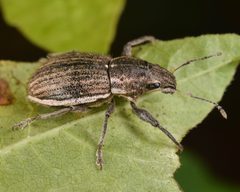
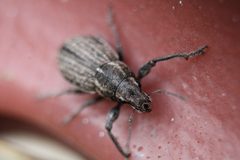
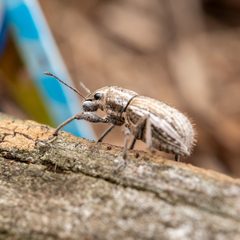
Distinguished from other Naupactus by the combination of , reduced and the two pale longitudinal bands on the dark grey body. In introduced ranges, the absence of males and flightless condition are diagnostic. N. cervinus (Fuller rose ) is similar but lacks the distinct banding pattern and has functional wings. Molecular or detailed morphological examination may be required for definitive identification within the N. leucoloma species group.
Images
Appearance
are 8–12 mm long and 4 mm wide at the , with a dark grey body marked by two lighter longitudinal bands running down the and . The body is covered with setae, longer on the forewings (). The elytra are and reduced in size, rendering adults flightless. Males are narrower in form than females. Larvae are approximately 12 mm long, legless, yellowish-white with black , and have partially retracted heads.
Habitat
In its native range, occupies fertile temperate plains with grass prairie and grass steppe vegetation, typically with sparse tree cover. In introduced ranges, found in agricultural settings, pastures, and areas with diverse herbaceous vegetation. occur on plant foliage; larvae inhabit soil around host root systems.
Distribution
Native to Argentina (provinces from Jujuy and Salta to Chubut), Uruguay, and southern Brazil. Introduced and established in United States, South Africa, Chile, Peru, Australia, and New Zealand. In New Zealand, first detected 1944, now widespread in North Island and recorded in Nelson, Blenheim, Christchurch, and Ashburton in South Island.
Seasonality
In New Zealand, active December through April. In North America, adult from occurs May through October, dependent on soil moisture. Adults live up to three months. Larvae hatch in New Zealand in May and in North America in August; late-season may overwinter and hatch the following year.
Diet
Highly . Larvae feed on roots of diverse plants; feed on leaves. Documented include alfalfa, beans, brassicas, carrots, clover, onions, potatoes, and many others—385 plant total. Blackberry and peanut foliage support high (averages of 538 and 1,532 per female, respectively).
Life Cycle
laid in clusters of 15–25 (up to 60) on ground near cover objects or directly into soil when penetration is easy. Incubation averages 14.7 days in mid-summer, extending to 62.4 days for late-season eggs; some overwinter. Larval stage lasts 10–17 months, passing through four or possibly five instars before pupating. duration varies with temperature: 14 days in warm months, up to 30 days in cold months. emerge and feed before reproducing.
Behavior
is exclusively parthenogenetic (thelytokous) in introduced ; all individuals are female. Males are rare and occur only in native South American range, possibly extinct in some areas. are flightless due to and reduced wings. are deposited near soil-cover object contacts or directly into accessible soil.
Ecological Role
In native range, presumably consumed by carabid beetles, mites (Histiostoma feroniarum), and birds including Milvago chimango chimango and Belonpterus chilensis chilensis. In New Zealand, House Sparrows (Passer domesticus) have been observed predating . No or documented in introduced New Zealand . As a pest, larval root herbivory can kill young plants and reduce yields in mature crops.
Human Relevance
Significant agricultural pest in introduced ranges. Larval feeding on roots causes major damage to beans, clover, potatoes, and numerous other crops. Less serious than small hive beetle (Aethina tumida) but nonetheless economically important. Subject to and control efforts in multiple countries.
Similar Taxa
- Naupactus cervinus (Fuller rose beetle)Similar size and general form, but has functional wings and lacks distinct pale longitudinal banding; also parthenogenetic and introduced in some regions
- Naupactus xanthographus (South American fruit tree weevil)Congeneric native to same region, but narrower male form and different associations (grapevine pest)
- Other Graphognathus/Naupactus speciesFormerly placed in separate Graphognathus based on reduced wings, now synonymized; require detailed examination for separation
Sources and further reading
- BugGuide
- Wikipedia
- GBIF taxonomy match
- iNaturalist taxon
- NCBI Taxonomy
- Catalogue of Life
- An Inordinate Fondness #9 | Beetles In The Bush
- An Inordinate Fondness | Beetles In The Bush
- blogging | Beetles In The Bush | Page 3
- October | 2010 | Beetles In The Bush
- Curculionidae | Beetles In The Bush | Page 3
- Biology of the white-fringed beetle (naupactus leucoloma boh.) /